


Blecher, Max, Occurence in Immediate Unreality,
trans. Alistair Ian Blyth, University of Plymouth Press, 2009, 125.
Epiphanies,
as Joyce called them, are one of modernism’s major tropes: instants of clarity,
of certainty, filched under the hegemonic gaze of anomie and doubt, humble and
fragmentary personal revelations, which gives their ecstatic recipient a taste
for absolute without ever giving her the words to tell it with, nor the
overarching narrative in which it could make sense1.
Among the plenitude
of senselessness in which the modernist characters are often left to make out
the contours, epiphanies act as both a plot element within the story, and a literary
device, kindred to both essayism and exposition, a chance encounter of a fabula and a syuzhet on a dissecting table. In one sense it constitutes for the
characters a return of the unreal (as well as a “revenge of the profane2”)
within a disenchanted world, and in the other, it allows the author to sacralise
a concept or an image by embedding it at both narrative levels.
This seems
to fit quite well what the “occurrences” of Blecher’s title account for:
Intrusions of the extraordinary within the narrow confines of the quotidian,
glimpses behind the stage curtain of a mousy and hypocritical reality.
To Blecher this narrow quotidian is that of his childhood and teenager years, that of the quiet life of the Jewish bourgeoisie in Roman, Moldova. Seen through the bewildered eyes of a child, and acknowledging the distortions of memory, the depiction the author gives us insist on the recurrent sense of absurdity: contrived mores, duty-bound to meaningless, cowardly, inconsequential commandments. All those who seem to retain his attention are outsiders, like the town’s madwoman, whom he depicts larger than life and mysterious, whereas his family or his school barely get a mention.
To Blecher this narrow quotidian is that of his childhood and teenager years, that of the quiet life of the Jewish bourgeoisie in Roman, Moldova. Seen through the bewildered eyes of a child, and acknowledging the distortions of memory, the depiction the author gives us insist on the recurrent sense of absurdity: contrived mores, duty-bound to meaningless, cowardly, inconsequential commandments. All those who seem to retain his attention are outsiders, like the town’s madwoman, whom he depicts larger than life and mysterious, whereas his family or his school barely get a mention.
Max Blecher
was born in 1909 and left his small-town life aged 18 to gain Paris, where he
intended to hone his skills as a writer under the enlightened guidance of the
surrealist avant-garde. Although he was to eventually distance himself from the
movement in its more ossified and orthodox forms, he would in a sense succeed
in integrating the group, keeping a lively correspondance in the following years with André Breton, as
well as other European figures like André Gide or Martin Heidegger.
But of more importance probably, is his being diagnosed shortly after arriving in France with a fatal and incurable form of spinal tuberculosis, which would first drag him throughout various sanatoriums around Europe (France, Switzerland and Romania), immobilize him in bed, and finally take his life a decade later, in 1938, when Blecher was barely 28. A short and tragic life if there ever was one, it is no surprise to find out that his condition had a tremendous impact on his writing, in terms of settings, of moods and maybe even of stylistic devices3.
But of more importance probably, is his being diagnosed shortly after arriving in France with a fatal and incurable form of spinal tuberculosis, which would first drag him throughout various sanatoriums around Europe (France, Switzerland and Romania), immobilize him in bed, and finally take his life a decade later, in 1938, when Blecher was barely 28. A short and tragic life if there ever was one, it is no surprise to find out that his condition had a tremendous impact on his writing, in terms of settings, of moods and maybe even of stylistic devices3.
He left behind four books, one a collection of poetry (Corps Transparent,
1934), one novel depicting experiences of his childhood (Întâmplări în
irealitatea imediată, 1936, translated Occurrence in the Immediate Unreality)
and two so-called “sanatorium novels” (Inimi cicatrizate, 1937, translated as
Cicatrised Hearts, and Vizuina luminată, published in full posthumously in 1971
and as of yet untranslated in English but referred to as the Illuminated Burrow
in Mironescu 2014); Instead of novels those stand somewhere closer to a diary “without
qualities” than to the somewhat stricter novelistic form of “Occurrence”. It is surprising the man has not gained
greater attention in the West since our readers are often fond of those short
and dramatic lives, and that his work is simultaneously concise, punchy, highly
original and very readable. Some have pointed out that the succession of
unhelpful regimes in Romania has certainly played a part in occulting his
legacy, but one could point out that it did not help Cioran either, and yet his
work is now fairly well circulated… At any rate he certainly deserves to be
better known!

Angeles Santos - Un Mundo - 1929
Early on,
his eccentric experience of world, those crises he thought so intrinsic to
himself and maybe to the world, are given a name by the family doctor:
“palludism” (p.34); But for Blecher this does not mean those incursions of the
unreal into the everyday will give him a chance of analysing them as symptoms,
nor does it mean the novel will remain on the fantastical threshold, between
the realm of the actual and that of the figure of speech4. Instead
as a child and as a teenager, he attempts to construct an ad-hoc framework to
answer his ever pressing need to give meaning to his experience. Both the
meaning of the real, and that of the unreal ultimately resist him, but this
theoretical and systematic inclination, if filtered through the mind of a
child, is one of the specificity of his books, as well as of his condition.
The experience of Blecher could be surmised under the two “traditional” categories of derealisation and depersonalisation, two symptoms common to both the psychotic trema5 and dissociative substances.When “growing distant from [him]self” (p.45), his “ body would have a bizarre stinging sensation of detachment” (p.65). Unlike the “warm” kind, those symptoms are not emotional but removed, even “distanciated” one could say, depicting not only the real as fictive and malleable, but the self as well, resulting in identity being dissolved with varying levels of intensity, into an illusory objectivity.
The experience of Blecher could be surmised under the two “traditional” categories of derealisation and depersonalisation, two symptoms common to both the psychotic trema5 and dissociative substances.When “growing distant from [him]self” (p.45), his “ body would have a bizarre stinging sensation of detachment” (p.65). Unlike the “warm” kind, those symptoms are not emotional but removed, even “distanciated” one could say, depicting not only the real as fictive and malleable, but the self as well, resulting in identity being dissolved with varying levels of intensity, into an illusory objectivity.
This
dissociation which pervades the novel is not without surrealist precedent: the
famed “automatic writing” meet Inuit throat singing in the the form of a
children game, where Blecher and a friend engage in fast-paced conversations
constructing increasingly absurd pastiche of grown-up gossiping: “the whole
conversation took on a kind of ethereal independence. It would float through
the room, detached from us like a curious bird. The existence of this bird was
wholly external, and had it really appeared among us, we would have no more
doubted it than we doubted the fact that our words were unconnected with us.”
(p.64)
But I depart from the “surrealist” interpretation of the text, where sexuality and the uncanny are seen as the two suns around which the mind of the young Blecher is orbiting, in that both fail to gain his appraisal, which he seems to reserve for an elusive sense of authenticity. The overall mood is one of tragedy, the narrator powerless not in the face of fate, but in that of the absurdity of life, of an irresolvable but also unbearable existential condition:
On the top of this first layer of absurdity comes a second one, that of the narrator recalling his past, with which he remain connected only by an eerie sense of nostalgia (“the mystery and rather sad charm of my childhood ‘crises’”, p.27) which a lingering, pacified and generalized form of the weltschmerz of his youth.
But I depart from the “surrealist” interpretation of the text, where sexuality and the uncanny are seen as the two suns around which the mind of the young Blecher is orbiting, in that both fail to gain his appraisal, which he seems to reserve for an elusive sense of authenticity. The overall mood is one of tragedy, the narrator powerless not in the face of fate, but in that of the absurdity of life, of an irresolvable but also unbearable existential condition:
On the top of this first layer of absurdity comes a second one, that of the narrator recalling his past, with which he remain connected only by an eerie sense of nostalgia (“the mystery and rather sad charm of my childhood ‘crises’”, p.27) which a lingering, pacified and generalized form of the weltschmerz of his youth.
In a letter
to Saşa Pană, Blecher writes his ideal would be a literary form akin to Dali’s
painting, oozing “a dementia perfectly legible and essential” ; But more
surprisingly he also finds that Dali’s paintings –and his ideal writing- should
prefer the decorum of daily life, to those “far away continents, abstract and
chimerical6”. Now to me, those of Dali’s paintings that are
“legible” are also those that look very much “chimerical”.
What we do find in both Dali and the “Occurrence” on the other hand, and which could be found in De Chirico7 before either of them, is the heightened sense of meaning, of contrived and overt meaning that translates best in terms of theatricality.
What we do find in both Dali and the “Occurrence” on the other hand, and which could be found in De Chirico7 before either of them, is the heightened sense of meaning, of contrived and overt meaning that translates best in terms of theatricality.

Gino Severini - Self-Portrait - 1912
Both during
and outside his crises, Blecher seems to demonstrate an odd relationship with things
and materiality in general. Ambiguous in their power, their quality
participates in the “tyranny of objects” (p. 32) from which Blecher longs to be
freed. Yet simultaneously they fascinate him, because they stand outside of the
real, or better even, in front of the flattened backdrop of the world at large.
As commodities, they contrast with the world which has produced them by openly
acknowledging their nature “of contorted and artificial objects” (76) and
Blecher continuously “encountered immobile objects, which were like walls
before which I had to fall upon [his] knees” (p.50).
Further on he tells us “I used to be impressed by everything that was an imitation” (p.56). Unsurprisingly, then, those objects that are redeemed from meaningless absurdity of the whole and given their own, self-standing quality, are often those which in their “self-conscious” artificiality, would be today called kitsch:
An engraving of the royal family which at close examination reveals it is formed of minuscule letters relating their royal biography (p.68), old-fashioned photographs depicting unknown predecessors in contrived theatrical poses and outfits (p.65), a wax cast of the inner ear (p. 51), a “superb, fine, grotesque and hideous” gipsy ring of brass and glass (p.56), etc.
Further on he tells us “I used to be impressed by everything that was an imitation” (p.56). Unsurprisingly, then, those objects that are redeemed from meaningless absurdity of the whole and given their own, self-standing quality, are often those which in their “self-conscious” artificiality, would be today called kitsch:
An engraving of the royal family which at close examination reveals it is formed of minuscule letters relating their royal biography (p.68), old-fashioned photographs depicting unknown predecessors in contrived theatrical poses and outfits (p.65), a wax cast of the inner ear (p. 51), a “superb, fine, grotesque and hideous” gipsy ring of brass and glass (p.56), etc.
“Among all
these things their reigned an air of perfect understanding (…) it was a life
reduced to a smaller scale, in a more restricted space, within the limits of
the letters and the photographs, like in a stage set viewed through the thick
lenses of a pair of binoculars, a stage set intact in all its components,
except minuscule and distant” (p. 65-66). For an instant, those objects at the
mercy of their playful agency seem to constitute a microcosm more likely to
retain the meaning the macrocosm had so far denied them. Elsewhere, “the fair
itself formed a world apart, whose purpose was to demonstrate the infinite
melancholy of artificial ornaments”(p. 62). Those elect objects constitute,
with the fascinating couple Paul and Edda, initiated to the mysteries of the
music-hall, an enclave resisting the banality and the pressure of provincial
life, full of promises and potential, simultaneously more genuine and more
openly artificial than the throngs of well-to-do conformists:
“I saw all too well the pointlessness and boredom in which they consumed their lives: the young girls in the park laughing stupidly; the merchant with wily self-important eyes; my father’s theatrical need to play the part of father; the cruel weariness of the beggars asleep in filthy corners; All these merged into a general and banal outward appearance, as though the world, such as it was, had long been waiting within me, constructed in its definitive form, while I, every day, did nothing more than verify its senescent contents in me.”
The beautiful Edda around whom revolve all men and all generations in the house, become for the young narrator a subject of obsession, whose fleeting eroticism share in the same comforting and fetishized materiality as all the props that have fascinated him. But as his fantasies, whichever they might be, fail to come into being, Edda and the objects starts painfully receding in the background, risking that “the variousness of the world enveloped them in the same uniform monotony” (p. 55);
“I saw all too well the pointlessness and boredom in which they consumed their lives: the young girls in the park laughing stupidly; the merchant with wily self-important eyes; my father’s theatrical need to play the part of father; the cruel weariness of the beggars asleep in filthy corners; All these merged into a general and banal outward appearance, as though the world, such as it was, had long been waiting within me, constructed in its definitive form, while I, every day, did nothing more than verify its senescent contents in me.”
The beautiful Edda around whom revolve all men and all generations in the house, become for the young narrator a subject of obsession, whose fleeting eroticism share in the same comforting and fetishized materiality as all the props that have fascinated him. But as his fantasies, whichever they might be, fail to come into being, Edda and the objects starts painfully receding in the background, risking that “the variousness of the world enveloped them in the same uniform monotony” (p. 55);
“All events
were thus destined to appear in my life jerkily and abruptly, incomprehensibly,
isolated in their outlines from any past. Edda became one more additional
object, a mere object, whose existence tormented me and exasperated me, like a
word repeated countless time, which becomes all the more meaningless the more its meaning seems imperiously
necessary” (p.76).
Objects,
and Edda among them, ultimately fail to bring solace to the young Max. The
celebration of their idiosyncrasy seems insufficient to take his mind off the
absurdity of the world, and they regain their regain their commodity condition,
Edda in death, and the objects beyond his reach.
“Behind
objects, no light was ever lit, however, and they forever remained bathed by
the volumes that hermetically sealed them, and which sometimes seemed to grow
thinner in order to allow their true meaning to show through.” (p.69)
But never does it actually show through in the book: the only revelation, the only truth that objects might bestow upon us, is a confession of their own artificiality. In other words, those are Cretan objects telling us the single truth that there is no truth to be found about them.
All in all, although Blecher partakes of the surrealist project of “détournement” attempting to abduct objects from their value-systems, retaining fetishism but discarding commodity, there comes from this practice no sense of empowerment, nor even escapism, merely a confrontation with the authentic, which in the aftermath of its ecstatic revelation shows itself no less alienating and absurd as the delusional layer it had been coated with.
But never does it actually show through in the book: the only revelation, the only truth that objects might bestow upon us, is a confession of their own artificiality. In other words, those are Cretan objects telling us the single truth that there is no truth to be found about them.
All in all, although Blecher partakes of the surrealist project of “détournement” attempting to abduct objects from their value-systems, retaining fetishism but discarding commodity, there comes from this practice no sense of empowerment, nor even escapism, merely a confrontation with the authentic, which in the aftermath of its ecstatic revelation shows itself no less alienating and absurd as the delusional layer it had been coated with.
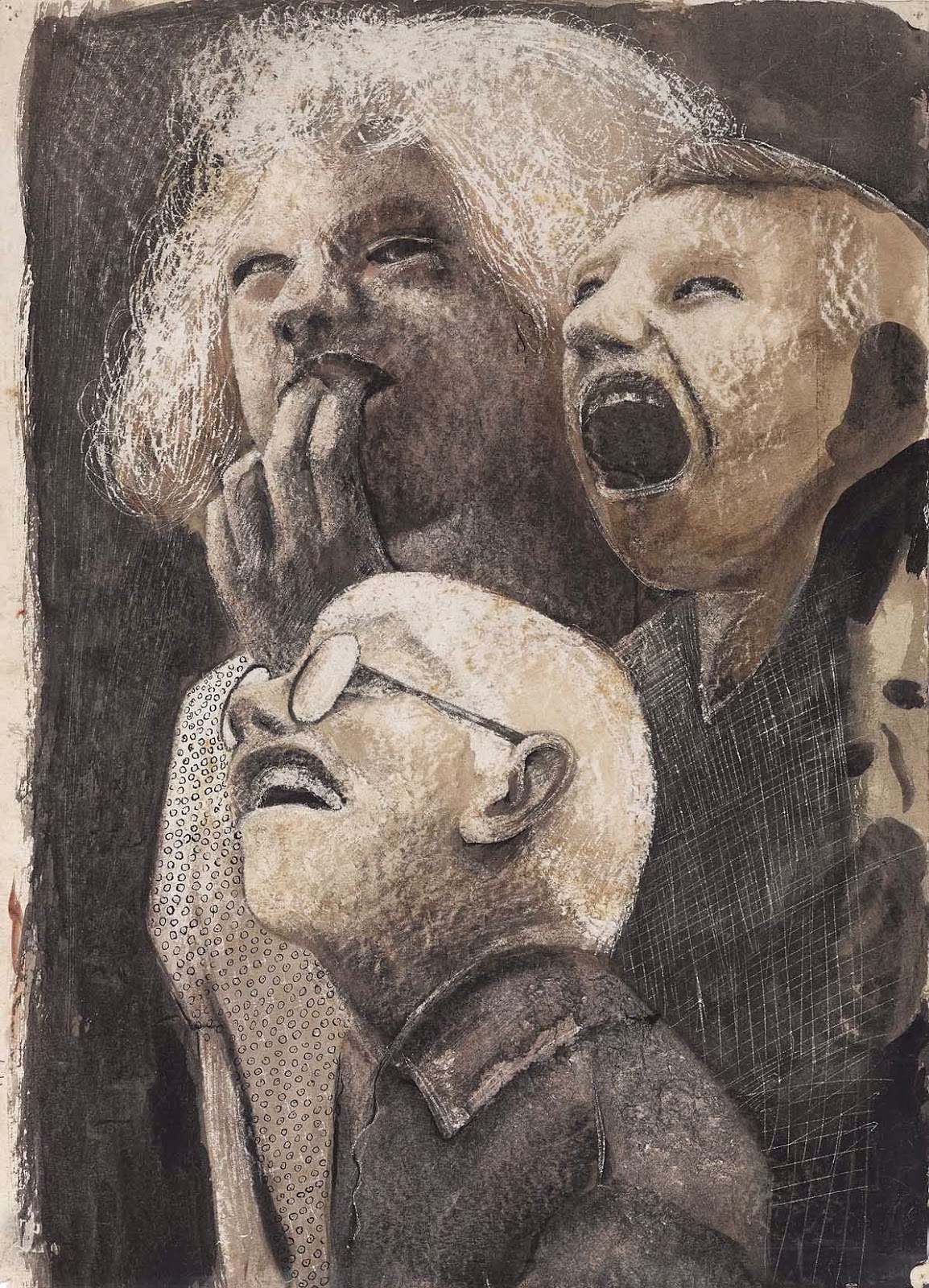
Johann Georg Müller - Kids - 1936
Haunting
the narrator and the narration through and through, is the continuous intuition
that the world –the social, civilized and utterly meaningless world- is staged:
“Life, in general, is pure theatre” (p.35). The result is Blecher’s denigration of vision, a “mistrust in
all that [he] saw” caused in part by his “myopia for the meaning of all things
around [him]” (p.68); Theatrum mundi is a rather common trope, it harks back to
the very origins of literature and was present in kindred authors of the period7.
Observing with a recurrent fascination the photographs collated in front of a photographer’s booth, he chances upon a photograph of himself. Instantly projected within the “smaller” and objectified world which those relics had put between his hands, he goes on a long and clear excursus shading in the common thread of his crises, between epileptic and metaleptic:
Observing with a recurrent fascination the photographs collated in front of a photographer’s booth, he chances upon a photograph of himself. Instantly projected within the “smaller” and objectified world which those relics had put between his hands, he goes on a long and clear excursus shading in the common thread of his crises, between epileptic and metaleptic:
“That
sudden encounter with myself, immobilised in a fixed attitude, there at the
edge of the fair, had a depressing effect upon me.
(…) In an instant I had the sensation of not existing except in a photograph. This inversion of mental positions often happened to me in the most diverse circumstances. (…) In an accident on the street, for example, I gazed for a number of minutes at what was happening as though at a hackneyed performance. All of a sudden, however, the entire perspective changed (…) although everything remained intact, it was suddenly as if I was the one that was lying stretched on the ground (…). Likewise, without any effort, as a logical consequence of the mere fact that I was looking, I used to imagine myself in the cinema, experiencing the intimacy of the scenes on the screen.” (p. 60)
It is interesting to note that he seems to find in the cinema the intimacy that real life, alienated from it as he is, seems to have largely refused him. In this sense, as much as an entorse à la représentation, the aporetic mise en abyme that keeps on intruding in young Blecher’s quotidian is a critique of visuality – a critique ad-absurdum since the image remain his favourite media – and in an important sense a hazy prefiguration of the critique of spectacle.
(…) In an instant I had the sensation of not existing except in a photograph. This inversion of mental positions often happened to me in the most diverse circumstances. (…) In an accident on the street, for example, I gazed for a number of minutes at what was happening as though at a hackneyed performance. All of a sudden, however, the entire perspective changed (…) although everything remained intact, it was suddenly as if I was the one that was lying stretched on the ground (…). Likewise, without any effort, as a logical consequence of the mere fact that I was looking, I used to imagine myself in the cinema, experiencing the intimacy of the scenes on the screen.” (p. 60)
It is interesting to note that he seems to find in the cinema the intimacy that real life, alienated from it as he is, seems to have largely refused him. In this sense, as much as an entorse à la représentation, the aporetic mise en abyme that keeps on intruding in young Blecher’s quotidian is a critique of visuality – a critique ad-absurdum since the image remain his favourite media – and in an important sense a hazy prefiguration of the critique of spectacle.
But just as with the objects and their small
worlds, the epiphany is always too short to retain more than an intuition, even
less to conclude as to the possible meaning of it all. The puzzle of the
hinterwelt, “snatching [him] away from everyday comprehension” (p. 61), appears
as little more than the extra-ordinary pendant to the absurdity of the
ordinary.

Odilon Redon - Light - 1893
As tension
reaches its climax, the young Max’s mind being driven into increasing hysterical
compulsions by his obsession for Edda, which stands alone in the emptiness of
his inner-life, the same honest, and therefore exceptional, materiality that
which had fascinated him in objects, reappear in the plot for a literal
experience of oceanic consciousness.
Quoting Simona Sora, Doris Mironescu has noted « Occurrence » was mystical rather than existential, as the later writings of its author would be. I am not sure the two need to be mutually exclusive, and the narration provides us with numerous instances of anguished interrogation (“Who am I?”), often, it is true, filtered through the visionary and concrete mind of a child, but no less existential for all that.
Quoting Simona Sora, Doris Mironescu has noted « Occurrence » was mystical rather than existential, as the later writings of its author would be. I am not sure the two need to be mutually exclusive, and the narration provides us with numerous instances of anguished interrogation (“Who am I?”), often, it is true, filtered through the visionary and concrete mind of a child, but no less existential for all that.
Alina Noir8
argues for a Jewish reading of Blecher’s “Occurrence”, but the evidence she
presents is rather thin, and somehow manages to dispute the author’s project of
reforming biographical writing.
Although Blecher’s “epiphanic” experiences fits in rather well with a multitude of other contemporary works, the presence of “bad places” is indeed idiosyncratic for any modernist mysticism. Post-nietzschean literature seems generally wary of the notion of evil, and when there is a theodicy it is generally a rather abtract condemnation of quantity or utilitarian reason. But is this enough to claim, as Noir does, that those places manifest the kilkul, the “cosmic damage” which Jewish piety is meant to mend? I doubt so, as Blecher’s bleak portrayal of samll-town life leaves little hope to “fix things up” at whichever level you might want to read him. In fact, he tells us early on that no tiqqun was accomplished in his childhood, that the “crepuscular state” which was once the attribute of “bad places” has become generalized, stripped even of its visionary features:
“When I embarked upon adolescence I no longer had crises, but the crepuscular state that preceded them and the profound sense of the world’s pointlessness, which followed upon them, somehow became my natural state.
The pointlessness filled the cavities of the world like a liquid that would have spread in all directions. And the sky above me, eternally prim, absurd and indefinite sky, took on the colour proper to despair.” (33)
To be sure, Blecher’s concern with the “sudden disappearance of identity” (27) might attest to an occulted interrogation of Blecher’s own middle-class Jewish background, likely obscured, as Noir argues, by the rising anti-semitism of the times. It suffices to look at the life-story of Mihail Sebastian, one of Blecher’s Jewish correspondents, to have an idea of the situation at the time9.
Yet, as much as the Romanian political climate, one could look at his formation in cosmopolitan Paris for a reason to his jewishness taking the back seat.
Although Blecher’s “epiphanic” experiences fits in rather well with a multitude of other contemporary works, the presence of “bad places” is indeed idiosyncratic for any modernist mysticism. Post-nietzschean literature seems generally wary of the notion of evil, and when there is a theodicy it is generally a rather abtract condemnation of quantity or utilitarian reason. But is this enough to claim, as Noir does, that those places manifest the kilkul, the “cosmic damage” which Jewish piety is meant to mend? I doubt so, as Blecher’s bleak portrayal of samll-town life leaves little hope to “fix things up” at whichever level you might want to read him. In fact, he tells us early on that no tiqqun was accomplished in his childhood, that the “crepuscular state” which was once the attribute of “bad places” has become generalized, stripped even of its visionary features:
“When I embarked upon adolescence I no longer had crises, but the crepuscular state that preceded them and the profound sense of the world’s pointlessness, which followed upon them, somehow became my natural state.
The pointlessness filled the cavities of the world like a liquid that would have spread in all directions. And the sky above me, eternally prim, absurd and indefinite sky, took on the colour proper to despair.” (33)
To be sure, Blecher’s concern with the “sudden disappearance of identity” (27) might attest to an occulted interrogation of Blecher’s own middle-class Jewish background, likely obscured, as Noir argues, by the rising anti-semitism of the times. It suffices to look at the life-story of Mihail Sebastian, one of Blecher’s Jewish correspondents, to have an idea of the situation at the time9.
Yet, as much as the Romanian political climate, one could look at his formation in cosmopolitan Paris for a reason to his jewishness taking the back seat.

Paul Klee - Girl in mourning - 1939
The
plurality of cohabitating meanings religion and post-structuralism have
ascribed to singular texts allow her to see in “Occurrence” that “Max Blecher
‘translated’ his Kabbalistic text into a Surrealist one”; But for a mere
contextual interrogation, in Blecher’s modernist context, kabbalah seem as
diaphane as any other tradition. Without a convincing elucidation of the
“intimate bond between Judaic mysticism and Surrealist literature” she alludes
to, I am hard-pressed to find any hint of the author’s religious education:
There is indeed a historical confluence of surrealism and messianic judaism, from Walter Benjamin and Ernst Bloch to Michael Löwy and Edmond Jabès, but one has to note that Blecher’s surrealism is hardly “messianic”: in fact there is in the book very little projection in the future, and certainly no political program, be it to overturn the calcified society of Roman, or hasten the revelation of the world’s obscured meaning. All takes place in the present and prooves to inarticulate, too fragmented, to be effectively recomposed into a project. If anything, the obsession with both commodity and spectacle is reminiscent of Guy Debord (““The satisfaction that the commodity in its abundance can no longer supply by virtue of its use value is now sought in an acknowledgment of its value qua commodity. A use of the commodity arises that is sufficient unto itself; what this means for the consumer is an outpouring of religious zeal in honour of the commodity's sovereign freedom10”)…
There is indeed a historical confluence of surrealism and messianic judaism, from Walter Benjamin and Ernst Bloch to Michael Löwy and Edmond Jabès, but one has to note that Blecher’s surrealism is hardly “messianic”: in fact there is in the book very little projection in the future, and certainly no political program, be it to overturn the calcified society of Roman, or hasten the revelation of the world’s obscured meaning. All takes place in the present and prooves to inarticulate, too fragmented, to be effectively recomposed into a project. If anything, the obsession with both commodity and spectacle is reminiscent of Guy Debord (““The satisfaction that the commodity in its abundance can no longer supply by virtue of its use value is now sought in an acknowledgment of its value qua commodity. A use of the commodity arises that is sufficient unto itself; what this means for the consumer is an outpouring of religious zeal in honour of the commodity's sovereign freedom10”)…
The most
truly religious experience of the book, and that where the flickering
silhouette of the Torah can be glimpsed at in the far distance, is that which
takes place in the mud field of the cattle market. At night Blecher, febrile
and agitated, approaches the field of ground and dung ploughed by the feet of
hundreds of animal during the day. With the night’s rain it has changed into an
ocean of mud, a “sublime mass of filth” (p. 88) revolting in smell and feel, in
which an ecstatic Blecher proceed to make his blasphemous ablutions, embracing
litterally the fruits of the earth.
At this point, the silhouette of materiality, which had haunted the book so far, comes into clear focus: man, and Blecher more than any other, has been shaped out of mud. Not however, by a benevolent god, as he has no ruach to claim his own, but only matter, incoherent and demiurgic, malign, even, probably: “Around me stretched the muddy vacant lot… This was my authentic flesh, flayed of clothes, flayed of skin, flayed of muscle, flayed to the mud.” (p. 89)
At this point, the silhouette of materiality, which had haunted the book so far, comes into clear focus: man, and Blecher more than any other, has been shaped out of mud. Not however, by a benevolent god, as he has no ruach to claim his own, but only matter, incoherent and demiurgic, malign, even, probably: “Around me stretched the muddy vacant lot… This was my authentic flesh, flayed of clothes, flayed of skin, flayed of muscle, flayed to the mud.” (p. 89)
As his
world spirals into insanity, punctuated by suicide attempts and delirious
dreams, he comes to the conclusion he is himself matter, gives him great
confidence and he goes to Edda. But Hylé is a jealous god, a river of mud in
which one cannot enter twice, because he would have to be carried away the
first time:
The mud idol, the comfort and torment of his life, the formless, meaningless and self-sufficient materiality of mud and things, must feel threatened for an instant by Blecher’s impossible love for Edda. But with her death, with her return to dust, “mud had entered the rooms, triumphant and insinuating, like a hydra with countless protoplasmic protuberances, (…) it spread along the walls, crawling up the people, climbing the scale and attempting to scale the coffin” (p.107);
The mud idol, the comfort and torment of his life, the formless, meaningless and self-sufficient materiality of mud and things, must feel threatened for an instant by Blecher’s impossible love for Edda. But with her death, with her return to dust, “mud had entered the rooms, triumphant and insinuating, like a hydra with countless protoplasmic protuberances, (…) it spread along the walls, crawling up the people, climbing the scale and attempting to scale the coffin” (p.107);
At first in
Blecher’s world there was only adulterated matter, matter that did not
acknowledged its own materiality, going through the demeaning process of
civilization and conformity, jumping through the hoops of delusional habits.
Then through objects peered the Great Materiality, the authentic, the real
thing: matter without civilization, pure in its abjection and fascinating as
much as terrible. Last came Edda, and the flicker of meaning which she might
have brought to his life. But all to quickly, jealous materiality wants her
back, and will not share the adoration Blecher.
“Something
in me was struggling somewhere far away, as it wished to prove to me the
existence of a truth higher than the mud, something that would be other than
mud. In vain… My identity had long since become veritable and now, in a most
ordinary way, all it did was to verify itself: in the world nothing existed
besides the mud.” (p. 108)
1 – See Hulin,
2008.
2 – See Gumbrecht 2012, 113.
3 – Tuberculosis affected a large number of modernist authors and characters, from Kafka, Katherine Mansfield to Hans Castorp, which was seen as “de-materializing” by Thomas Mann and D.H. Lawrence.
4 – See Todorov 1976.
5 – See Alistair Ian Blyth’s preface, Blecher 2009, 23. He interestingly defines those crises as manifesting the “empty transcendence of Modernism: an anxious, heightened sense of meaningfulness, but one devoid of cognisable content” (p.24); B – Giorgio de Chirico’s memoirs – as well as his paintings.
6 – See Goldiş 2007, 45.
7 – See De Chirico 1971. Much more than French Surrealism, Blecher could be said to echo Chirico's metaphysical objectivity : "one must picture everything in the world as an enigma…To live in the world as if in an immense museum of strangeness, full of curious many-coloured toys which change their appearance, which like little children we sometimes break to see how they are made on the inside." quoted here.
8 – See Noir 2000.
9 – Sebastian, 2003.
10 – Debord 1994, §67.
2 – See Gumbrecht 2012, 113.
3 – Tuberculosis affected a large number of modernist authors and characters, from Kafka, Katherine Mansfield to Hans Castorp, which was seen as “de-materializing” by Thomas Mann and D.H. Lawrence.
4 – See Todorov 1976.
5 – See Alistair Ian Blyth’s preface, Blecher 2009, 23. He interestingly defines those crises as manifesting the “empty transcendence of Modernism: an anxious, heightened sense of meaningfulness, but one devoid of cognisable content” (p.24); B – Giorgio de Chirico’s memoirs – as well as his paintings.
6 – See Goldiş 2007, 45.
7 – See De Chirico 1971. Much more than French Surrealism, Blecher could be said to echo Chirico's metaphysical objectivity : "one must picture everything in the world as an enigma…To live in the world as if in an immense museum of strangeness, full of curious many-coloured toys which change their appearance, which like little children we sometimes break to see how they are made on the inside." quoted here.
8 – See Noir 2000.
9 – Sebastian, 2003.
10 – Debord 1994, §67.
Blecher,
Max, Occurrence in the Immediate
Unreality, University of Plymouth Press, 2009, 125.
Debord, Guy, The Society of Spectacle, trans. Donald N. Smith, Zone Books, 1994, 64.
De Chirico, Giorgio, Memoirs, University of Miami Press, 1971, 262.
Goldiş, Alex. L’utopie littérale ou la communication à travers lesobjets. Un avant-gardiste atypique. Synergies Roumanie (2007) num 2, p. 45.
Gumbrecht, Hans, Atmosphere, Mood, Stimmung: On a Hidden Potential of Literature, Stanford University Press, 2012, 152.
Hulin, Michel, La mystique sauvage, PUF Quadrige, 2008, 313.
Mironescu, Doris. The ‘New Autobiography’ in 1930s Romania: M. Blecher, The Illuminated Burrow. Dacoromania Litteraria (2014) vol.1, p.107.
Noir, Alina, Max Blecher – the poetics of unreality, Respiro, num. 22, (accessed 15.12.14).
Sebastian, Mihail, Journal 1935-944: The Fascist Years, Pimlico, 2003, 641.
Todorov, Tzetan, Introduction à la littérature fantastique, Seuil, 1976, 188.
Debord, Guy, The Society of Spectacle, trans. Donald N. Smith, Zone Books, 1994, 64.
De Chirico, Giorgio, Memoirs, University of Miami Press, 1971, 262.
Goldiş, Alex. L’utopie littérale ou la communication à travers lesobjets. Un avant-gardiste atypique. Synergies Roumanie (2007) num 2, p. 45.
Gumbrecht, Hans, Atmosphere, Mood, Stimmung: On a Hidden Potential of Literature, Stanford University Press, 2012, 152.
Hulin, Michel, La mystique sauvage, PUF Quadrige, 2008, 313.
Mironescu, Doris. The ‘New Autobiography’ in 1930s Romania: M. Blecher, The Illuminated Burrow. Dacoromania Litteraria (2014) vol.1, p.107.
Noir, Alina, Max Blecher – the poetics of unreality, Respiro, num. 22, (accessed 15.12.14).
Sebastian, Mihail, Journal 1935-944: The Fascist Years, Pimlico, 2003, 641.
Todorov, Tzetan, Introduction à la littérature fantastique, Seuil, 1976, 188.


