1

Showing posts with label Contemporary. Show all posts

Wednesday, 26 March 2014

My Nightmare Yields

“Unprincipled men tried to malign our time. Always we had to look back, always we had to be modelled on another time. But my nightmare yields. Yes, our time is beautiful. So beautiful, that I don’t want to live in another.”
Adolf Loos, quoted here

Farkas Molnar - The red cube - 1923
via Ross Wolfe

Gloria Freedman - Le Carré Rouge - 1997

Luis Barragan - Casa Gilardi - 1976
photography by Kim Zwarts, 1988

Tuesday, 20 August 2013

Virtuous State

"The love of variety is a vicious, corrupt, and unnatural taste and could not prevail in any great degree in a simple and virtuous state of society."

Haus KLR built by Jutta Klare and renovated by Archequipe - Cologne - 1980 & 2013
Via Dezeen

Adolf Loos - Villa Moller - Vienna - 1927/28

 Aldo Rossi - Scuola Elementare De Amicis - Broni - 1969/1971

Thursday, 18 July 2013

Only the middling sort

“Modern toleration is really a tyranny. It is a tyranny because it is a silence"
G. K. Chesterton, Illustrated London News, October 10, 1908


Paul Strand - Wall Street - 1915 


Livio Vacchini - Palestra Gymanisum - 1995/7


Micahel Levin - New Concrete - 2009


“Extremely happy men and extremely unhappy men are equally disposed to harshness: witness monks and conquerors. Only the middling sort, and the mixture of good fortune with bad, offer gentleness and pity.” 
Montesquieu, The Spirit of the Laws, Bk VI, Ch IX

Sunday, 16 June 2013

The name of infidel - Simon Ungers

“Go into the Exchange in London, that place more venerable than many a court, and you will see representatives of all the nations assembled there for the profit of mankind. There the Jew, the Mahometan, and the Christian deal with one another as if they were of the same religion, and reserve the name of infidel for those who go bankrupt.” 
Voltaire, Philosophical Letters, 1734


Simon Ungers - Cathedral from the series Seven Sacred Spaces - 2003

Simon Ungers - Cathedral from the series Seven Sacred Spaces - 2003

Simon Ungers - Cathedral from the series Seven Sacred Spaces - 2003

Saturday, 6 April 2013

A Spacious Hive

"A Spacious Hive well stock'd with Bees,
That lived in Luxury and Ease;
And yet fam'd for Laws and Arms,
As yielding large and early Swarms;
Was counted the great Nursery,
Of Sciences and Industry."
Bernard Mandeville, The Fable of the Bees, 1705

John Leighton - Plan for hexagonal boroughs - 1865 - via Kosmograd

Konstantin Melnikov - Melnikov House - 1927 - Moscow

Du Besset-Lyon Architects - Lons le Saunier Library And Cinémas - 2012 - via ArchDaily

Wednesday, 23 January 2013

Unspeakable Space

“When a work is at its peak in intensity, proportions, quality of execution, in perfection, 
there occurs a phenomenon of unspeakable space. 
The areas start shining, radiating, physically they radiate.”
Le Corbusier, quoted by Gavin McKeeney

Giovanni Guerrini, Ernesto Bruno La Padula, Mario Romano - Palazzo Della CiviltĂ  - 1938/1943 - by Agugiaro

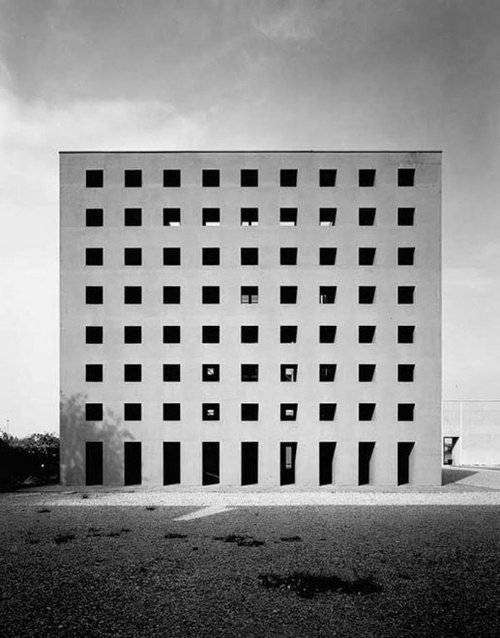
Aldo Rossi - San Cataldo Cemetary - 1978/? - Picture by Gabriele Basilico 2007

Yi Architects - Stuttgart Municipal Library

"architecture is not simply construction, or even the satisfaction of material needs; it must be something more [...]. Only when a harmony of proportions is reached, inducing the observer to pause in contemplation or emotion--only then will the constructive scheme have become a work of architecture."
Giuseppe Terragni, Caro Guardiano, 23 March 1931

quoted in David Rifkind, The Battle for Modernism, 2013

Saturday, 22 December 2012

Ministers of Sound and Volume

“Le Temps et l’Espace sont les ministres du Son et du Volume.” 
(Time and Space are the ministers of Sound and Volume)
Reflexions, G. Vantongerloo, in De Stijl, volume 1 issue 9, translation mine

Frank Lloyd Wright - Detail from the Hollyhock House - 1919-1921

Michael Hansmeyer Studio - Cellular Automata - Voxel- 2009

"Time and Space died yesterday. We are already living in the absolute, 
since we have already created eternal, omnipresent speed."
F. T. Marinetti, Futurist Manifesto., 1909

Friday, 21 December 2012

All That Is Solid Melts into Air - Marshall Berman

"Suppose, as Marx supposes, that bourgeois forms decompose, 
and that a communist movement surges into power: 
what is to keep this new social form from sharing its predecessors fate 
and melting down in the modern air?"
Marshall Berman, All That Is Solid Melts into Air, 1982

Monolithic, solid, liquid - the ubiquitous and pervasive influence of modernity has inspired an array of metaphors, so many images that reflect the peculiar interpretations of the modern as a supra-historical force. If modernism's spirituality, as I suspect, is a mystique of history, the indefinable and evasive nature of modernity calls for poetic and negative definitions, not unlike the rich paraphrase that fueled two thousand years of Christianity. 

Marshall Berman - All That Is Solid Melts into Air - 1982


Marshall Berman in All That is Solid Melts into Air apply himself at identifying the history and typology of the modern phenomenon, at producing a different theology -and anthropology- of modernity, solidly rooted in his broad knowledge of literary and intellectual history. 

If modernism is religious in character, it asks from it's students a leap of faith: although the sweeping changes to all landscapes that are described artfully in the book are undeniable, many an interpretation can seem at time to read too much in those events, to find groundbreaking novelty were others could find only the insatiable repetition of age-old conflicts. But this is hardly specific to Berman's views, in fact, it is the rule of the game.The identity between modernism and modernity that Berman seems to presuppose made me at times uncomfortable, I will prefer Paul Greenhalgh's understanding of modernism as a self-conscious phase of modernity, but if such broad concept as a monolithic modernity is to be examined, we will have with to acknowledge modernity as a force, be it a "real" historical phenomenon or at least as a cultural one, undeniably reigning over our collective imagination. 

His understanding is, and this seems to be the originality of his work, intrinsically rooted in a geographical, as well as historical, understanding of the process: the book is structured around five cities, which he presents as five types and five epochs of modernity as a process, each with their own idiosyncratic appropriations and reactions to the cultural, political and social upheavals that characterize the new era. 

Theo Van Doesburg - Arithmetic Composition - 1930


The five sections: first we are guided around the historical phenomenon of modernization by Faust and his various incarnations whom Berman agreeably identifies as the foremost metaphor of the period. The very ambivalence of modernization, offering both unlimited power and insatiable corruption of the established order of things, is highlighted as mephistophelian and, in the process ascribed the fitting role of funding myth in the spirituality he outlines. We then proceed to examine the poetics, and latent spirituality of Marx's thought: beyond the obvious themes of eschatological revolution he identifies what I am tempted to call "gaseous modernity": all that is solid melts into air, and air itself keeps on melting further and further -from air to ether most likely- modernity is here defined as the unstoppable and universal process that brings all things to an end. The process, that is in my eyes, history, is the sole permanence in this world, and therefore the inaccessible source of all transcendence. 

"For dialectical philosophy nothing is final, absolute, sacred. It reveals the transitory character of everything and in everything; nothing can endure before it except the uninterrupted process of becoming and of passing away, of endless ascendancy from the lower to the higher. And dialectical philosophy itself is nothing more than the mere reflection of this process in the thinking brain."
Frederick Engels Ludwig Feuerbach and the End of Classical German Philosophy, 1886

Next comes Baudelaire and Paris, which I found to be probably the most compelling section of book, maybe because it was the subject I was the least familiar with: once again the ambivalence of the poet is found to reflect the inbuilt contradiction of modernization, albeit here one that reflects a very material and physical process rather than spiritual or ideological: urbanization. Berman artfully outlines the new spectacles that radical changes in urban life brought to European culture: the confrontation between bourgeoisie and misery, the objectification of the crowds, their links with material and consumer culture and the blossoming society of spectacle. 

We then proceeds to examine, but with a different lens, the "modernism of underdevelopement" he finds in Saint Petersburg. Here is a world apart for Berman, where the spectacle of modernity he identified in the previous chapter take a life of it's own, split from the modernization process. He proceed to identify a form of surrealism he takes to be characteristic of Petersburgian literature  where everyone, from Dostoevsky to Biely, is an ardent humanist, whose ethical concerns are best expressed not in political statements or an ethical praxis, but in their tackling of the strange and the surreal. 
The shortcomings of the soviet regime are bundled together with the autocratic rule of Tsarist Russia in an attempt at imposing "from above" the appearance of modernity, that is, it's technical apparatus, without allowing the process to bring about social and political shifts that can support it. This of course, is reminiscent of the theories ascribing the rise of fascism to Germany and Italy's late modernization, and whereas the argument certainly hold some truth in economic terms it fits awkwardly in a work that belong clearly to cultural and literary history. This results in a very idealist distinction between modernization "from above" and modernization "from below", but more on this later - for now let me just say that his depiction of Tsarist Russia could well be ascribed to his own category of the "pastorals", of fictious and mono-dimensional representations which here allow for a slightly Manichean representation. Lastly a short chapter takes un around NYC which was a compelling read on a field I have virtually no knowledge of, and on which I will therefore refrain to comment. 

Henri Cartier Bresson - Arbres en Brie - Brie - 1968


As compelling a thesis as Berman's, one is bound to have qualms with anyone's interpretation of a concept as broad as modernity. Mine comes with his notion of "Modernization from below" which emerges towards the end, as the analysis take on a more decidedly political turn. The author largely eclipses his own political views in most of the book, as a genuine "theology of modernity" owes to do, keeping them checked in all of his analyses, but it seems that when acknowledging the failure of the soviet regime he feels the need to characterize the soviet project, so as to protect the ethical viability of modernist politics. 
For him, it seems, state-led modernization such as the soviet project, or other guises of authoritarianism he hinted at earlier in the book (Hausmann's urbanism, the Goethean Faust's pursuit of modernization, etc.) belong to the family of "modernization from above", a claim I would be at a loss to reject, but which he goes on to posit in opposition with what he calls the "modernization from below". 


But the paradox he seems willing to ignore is that modernization, if taken outside of the pure field of scientific history, and as he does throughout the book, in the field of cultural history, is essentially a collective phenomenon: modernizing has been done on smaller scales throughout history, but modernity arise with the awareness of the process, an awareness that propels the phenomenon on a cosmic scale (or at least a "suprahistorical" one) and feed onto the very self-reflexivity he so compellingly outlined.
There can only be a "modernization from below" if the said "below" is taken as a group, as a collective, else none of the crucial awareness brought about by modernization will be allowed to exist. To presuppose that the "below", the undifferentiated mass of individuals undergoing modernization, can do so and reflect on the process, requires a "methodological collectivism" allowing for collective identity, wich in my eyes is bound to bring about the very normative and monolithic modernity he is also so eager to reject:


Berman attaches himself at bringing to light what he understands to be a humanistic modernity - an excruciating task no doubt, given the permanent striving of modernists to surpass the boundaries of what they perceive as an outdated concept - this leads him to focus on the self-reflexivity to be found in many of the thinkers he examines, highlighting their shared anguish and something akin to humility, in their restless criticism of everything that surrounds them, including themselves. 
The problem I perceive is that this emphasis relegates a large section of modernity, and of modernism in particular, to the realm of the pathological or reactionary, from the futurists to the CIAM. One could be tempted to absolve him on the grounds of writing in the era of post-modernism, but his animosity towards what I find to be the most stalwarts, unequivocal proponents of modernism seem to be largely an ethical biais: his fascination for the contrary impulses and the psychology of the modern thinker cannot accomodate those movements that appear to embrace modernity in all it's monolithic and crushing unity, they refuse the fragmentary mindset he set out to explore. Does this mean that he owes to deny those manifestations' fundamental modernity? I think not: if indeed self-reflexivity and dualism are characteristics essential to the radical critique (as Greenhalgh would have it) of modernity, the 'total identification' of modernists with modernity is at the very least worth more attention than he gave them. 


Anthony Gormley - Body and Light - 1990


All in all, this is one of those books, beyond all discussions of it's theoretical analysis, whose sheer culture and depth of thinking amply justifies the reading: the author sweeps across the fascinating multitude of modernisms, battles heroically with their contradictions and parting this blood-red sea leads us not to the inchoate Eden of post-modernity but in the Promised Land of a new modernity, a plural one that rely on self-reflexivity to accommodate it's inner contradictions while retaining those of it's ideals that he finds compatible with his humanistic worldview. 
The question as to whether humanism is to find it's place in modernity is probably what actually separate me from his stand point, and I would be more inclined to see in modernity, and especially in modernism, a striving for the supra-human that is bound to negate humanity as a de-facto community. 
Yet surprisingly Berman also echoes, better than most, my understanding of modernism as a religious point of view: he insists on translating Marx's use of "Geist" as spiritual rather than intellectual, and his grasp of the very self-reflexivity of modernism acknowledges the inherent mythical mechanisms involved in the process. 
My copy is scribbled all over and I can only wish there had been larger margins for me to take notes and I will no doubt both explore further many of the authors he has engaged with, and come back to the book in the future as a reference on a meaningful thinker. 

Thursday, 13 December 2012

Traffic

"On that 1st of October, 1924, I was assisting in the titanic rebirth of a new phenomenon... traffic."
Le Corbusier, The City of Tomorrow. 1924, quoted in All That is Solid Melts into Air, Marshall Berman, 1982

Cornelis Van Eesteren - Schematic representation of the optimal relationship between skyscrapers and traffic - 1926

Le Corbusier - La Cité Radieuse - 1924

Emilio Ambasz - Cooperative of a Mexican-American grape growers in California - 1979

Wednesday, 12 December 2012

Nor the splendor of time - Antony Gormley, Model

"But what is it that I love in loving thee? Not physical beauty, nor the splendor of time, 
nor the radiance of the light -so pleasant to our eyes- nor the sweet melodies of the various 
kinds of songs, nor the fragrant smell of flowers and ointments and spices; not manna and honey, 
not the limbs embraced in physical love -it is not these I love when I love my God. 
Yet it is true that I love a certain kind of light and sound and fragrance 
and food and embrace in loving my God, who is the light and sound and fragrance 
and food and embracement of my inner man"
Saint Augustine, The Confessions, Book X, Chapter 6


The Antony Gormley "Model" exhibition at the White Cube gallery runs from the 28th of November to the 10th of February. Most of the opinions ascribed to the artist where expressed at his discussion with Tim Marlow on the 12th of December 2012. 


Theo Van Doesburg - Study for rhythm of a russian dance - 1918


Antony Gormley's career echoes masterfully many of the concerns I have so far displayed on this blog: his work address what has been described as a return to modernity, but a re-constructed modernity, largely freed from it's inbuilt contradictions, from it's ruthless violence and it's teenage angst, leaving only the poetics of reason and the mystique of abstraction. 
Gormley is not alone in this pursuit, but whether him or the others are genuinely moved by the crushing ideals of high modernism, or whether they are content to re-enact those glory days as an heroic (if futile) last stand against the post-modern wasteland, I cannot tell. In either case they have my sympathy. 


Antony Gormley - Transfuser - 2002


Gormley's sculpture addresses many of the "traditional" themes of monolithic modernity: the multitude, harmony, abstraction, or proportions, but generally through the conceptual lens of the human body, which seems to provide him with a permanent referential around which to build his rational aesthetics. 
His new show continues in this vein, exploring the body as a space we inhabit. 

The entire exhibition is an aggregation of rectangular cuboids, in different materials (from corten to polystyrene  via wood, cast metal and plastic) and in a variety of scale, from the toy soldier to the pavillon. 
We can identify three parts to the exhibition, three main scales of work: the smaller works are all to be found in one room, which seem essentially to document the conceptual and technical process that brought us the larger works. The process in question is essentially one of abstraction, where the human body, it's shapes and it's proportions, is gradually simplified into a combination of angular boxes, much reminiscent, in it's later stages,  of Malevitch' Architekton. 


Antony Gormley - Mark - 2012


The medium scale is one more or less consistent with actual human proportions: what at first appear like an abstract accumulation of blocks reveal, at closer inspection, human bodies, playfully disposed in natural, and not so natural positions, around the gallery space, like so many dancers frozen into intimate performances, but boxed, reduced to the space they occupy. 

The third scale, and judging from the talk given by the artist, the central work, is a rather gigantic construction of metal sheets which the visitor is first invited to circle, to study as a gigantic sculpture, before being invited, like Job, to enter in a Hobbesian Leviathan. 

Perambulating inside the controlled space proves to be as compelling an experience as promised by the artist: the complex interplay of surfaces, planes and light make for many surprising vistas and interactions, prompting intense experiences mixing claustrophobia, disorientation and exploration; Like a concrete presentation of St Theresa's Interior Castle we visit a space so stripped of signification that we can project our elusive, innermost realities onto it. 


Antony Gormley - Model - 2012


Space and architecture as a metaphor for inner life is itself an important modern concept (as described by Frances Yates)  and Gormley is fond of colliding this subjective, intimate construction of psychological architecture with the harsh, brutal(ist) materiality of the world he constructs - his rhetoric allies the pervasive abstraction of mystique and Platonism with the materiality sculpture as an exploration of space. The modern meet the modernist. But ultimately his work seems to address the power of the metaphor, organic and spatial. 
The exhibition is compelling on more than one ground: for it's stretching of the boundaries of the gallery experience, as one has come to expect from international artists, but also for his very refined take on modernity, whose latent mystic and spirituality will hopefully take part in shaping the supposed revival of modernism. 


Antony Gormley - Model - 2012


Yet this very mystique can also leave one wanting: If Le Corbusier's houses were machines to live in, what is the purpose of Gormley's? The new modernist paradigm seems keen to conciliate art for art sake with pure contemplation, and when Gormley characterizes his work as a tool, as "machine" one is tempted to say, he remains elusive as to its purpose: oceanic feelings, self-exploration, or inverted allegories of the cave all sound very much contemplative in essence. 
Contemplation is an activity essentially solitary, inward and subjective, even leaving little room for the contradictory maelstrom of opinions and ideals the modern culture cater to. The very elusiveness of the absolute the artist seems to invite us to pursue leaves a gaping void in both his work and his theory, which one can only wonder at. If modernism is to be revived in all it's claims of purity and high-mindedness, not only as a style or a facade, but as a genuine, heartfelt ideal, surely tolerance, accessibility and marketability will have to make room for an absolute, transcendent telos that will suffer no contradiction.


Oskar Schlemmer - Illustration for "Man and Art Figure" - in Theater of the Bauhaus - 1925

Sunday, 18 November 2012

Free from Change

“...all god is good, free from passion, free from change. 
For whatever suffers change does so for the worse or the better; 
if for the worse, it is made bad; if for the better, it must have been bad at first.” 
Sallustius, On the Gods and the Cosmos, I

In continuation of The Circle of Things

Architecture Without Architects - Value Model Of Central Copenhagen - 1970
via Nicolas Moulin

Joseph Hoffman - Untitled Cubist Sculpture - 1902

Suppose Design Office - T Clinic - Kure City

Thursday, 8 November 2012

The Second Time as Farce

"Hegel remarks somewhere that all great world-historic facts and personages appear, 
so to speak, twice. He forgot to add: 
the first time as tragedy, the second time as farce."
Karl Marx, The Eighteenth Brumaire of Louis Bonaparte, 1852


Kasimir Malevich - Suprematism (?) - 1915

Blue Noses - Kitchen Suprematism - 2005

Frank O. Gehry - Winton Guest House - 1983 to 1986

Wednesday, 7 November 2012

Mathew Borrett - Dwelling of the Gods

“Therefore we ought to try to escape from earth to the dwelling of the gods as quickly as we can; 
and to escape is to become like God, so far as this is possible.” 
Plato, Thaeatetus


Mathew Borrett - Exploring a Hypnagogic City


Mathew Borrett - Hiding Places


Mathew Borrett - Sleeping With The Window Open


Mathew Borrett - Some Memories Are Flooded

Mathew Borrett - Untitled

Friday, 5 October 2012

Espen Dietrichson - Social Fragmentation

“Objections to what many saw as a series of dualisms in Kant’s
philosophy intersected with Hegel’s concerns with social fragmentation, 
linking notions of social fragmentation to a notion of an internally divided self.” 
Thomas A. Lewis, Religion, Modernity and Politics in Hegel


Espen Dietrichson - Birds IV (2) - 2009


Espen Dietrichson - Birds IV (2) - 2010


Espen Dietrichson - Birds IV - 2010


Espen Dietrichson - Variations On A Dark City 1 - 2012


Espen Dietrichson - Variations On A Dark City 2 - 2012


Espen Dietrichson - Variations On A Dark City 4 - 2012