1

Showing posts with label Sculpture. Show all posts

Thursday, 18 April 2019

Symmetries

Peter Behrens - Der Kuß - 1898

Constantin Brâncuși - Le Baiser -1907

Franz Wilhelm Seiwert - Der Kuß - 1933

Thursday, 21 September 2017

Hieratic

Dénes Györgyi, Móric Pogány, and Emil Tőry - Hungarian Pavilion - Turin Universal Exhibition - 1911

Henri Gaudier-Brzeska - Hieratic head of Ezra Pound - 1914

Theo van Doesburg - Banister post - Alkmaar - 1917

Friday, 25 August 2017

Forebearance

Sandro Botticelli - Mary with the Child and Singing Angels (detail) - ca. 1477

Gustave van de Woestyne - La paysanne - ca. 1925

Adolfo Wildt - Un rosario - 1915-7

Saturday, 28 March 2015

Inferior Universe

“Here an inferior universe, gridded, compartimented, geometrical, 
offered itself to the gaze of the heavenly wanderer.”
Paul Morand, Fleche d'Orient, 1932

Fedele Azari - Volo Liberato (Prospettive in volo) - 1926
via Kafka's Appartment

Josef Albers - Transparence and Space-illusion - in Interaction of Color - 1963

Donald Judd - Untitled - 1989

Tuesday, 21 January 2014

Above Average

Today the Wise men of art call this work megalomania. They are right. Everything which exists above the average is a mania. I hear that the verdict passed on Russian work is: mechanomania.
 El Lissitzky, “Architecture in the USSR”, 1924


Jorge Oteiza - Conclusió experimental per a Mondrian - 1973

Sol Lewitt - Incomplete Open Cube - 1968

Gerrit Rietveld - Steltman Chair - 1963

Friday, 14 June 2013

The Chains of my Mortality

"I had been deafened by the clanking of the chains of my mortality"
Saint Augustine, The Confessions, 397-398


Jacob Epstein - Rockdrill - 1913


Gustav Klutsis
- Multilingual propaganda machine - 1925


Richard Vergez - Boost - 2007

Wednesday, 12 December 2012

Nor the splendor of time - Antony Gormley, Model

"But what is it that I love in loving thee? Not physical beauty, nor the splendor of time, 
nor the radiance of the light -so pleasant to our eyes- nor the sweet melodies of the various 
kinds of songs, nor the fragrant smell of flowers and ointments and spices; not manna and honey, 
not the limbs embraced in physical love -it is not these I love when I love my God. 
Yet it is true that I love a certain kind of light and sound and fragrance 
and food and embrace in loving my God, who is the light and sound and fragrance 
and food and embracement of my inner man"
Saint Augustine, The Confessions, Book X, Chapter 6


The Antony Gormley "Model" exhibition at the White Cube gallery runs from the 28th of November to the 10th of February. Most of the opinions ascribed to the artist where expressed at his discussion with Tim Marlow on the 12th of December 2012. 


Theo Van Doesburg - Study for rhythm of a russian dance - 1918


Antony Gormley's career echoes masterfully many of the concerns I have so far displayed on this blog: his work address what has been described as a return to modernity, but a re-constructed modernity, largely freed from it's inbuilt contradictions, from it's ruthless violence and it's teenage angst, leaving only the poetics of reason and the mystique of abstraction. 
Gormley is not alone in this pursuit, but whether him or the others are genuinely moved by the crushing ideals of high modernism, or whether they are content to re-enact those glory days as an heroic (if futile) last stand against the post-modern wasteland, I cannot tell. In either case they have my sympathy. 


Antony Gormley - Transfuser - 2002


Gormley's sculpture addresses many of the "traditional" themes of monolithic modernity: the multitude, harmony, abstraction, or proportions, but generally through the conceptual lens of the human body, which seems to provide him with a permanent referential around which to build his rational aesthetics. 
His new show continues in this vein, exploring the body as a space we inhabit. 

The entire exhibition is an aggregation of rectangular cuboids, in different materials (from corten to polystyrene  via wood, cast metal and plastic) and in a variety of scale, from the toy soldier to the pavillon. 
We can identify three parts to the exhibition, three main scales of work: the smaller works are all to be found in one room, which seem essentially to document the conceptual and technical process that brought us the larger works. The process in question is essentially one of abstraction, where the human body, it's shapes and it's proportions, is gradually simplified into a combination of angular boxes, much reminiscent, in it's later stages,  of Malevitch' Architekton


Antony Gormley - Mark - 2012


The medium scale is one more or less consistent with actual human proportions: what at first appear like an abstract accumulation of blocks reveal, at closer inspection, human bodies, playfully disposed in natural, and not so natural positions, around the gallery space, like so many dancers frozen into intimate performances, but boxed, reduced to the space they occupy. 

The third scale, and judging from the talk given by the artist, the central work, is a rather gigantic construction of metal sheets which the visitor is first invited to circle, to study as a gigantic sculpture, before being invited, like Job, to enter in a Hobbesian Leviathan. 

Perambulating inside the controlled space proves to be as compelling an experience as promised by the artist: the complex interplay of surfaces, planes and light make for many surprising vistas and interactions, prompting intense experiences mixing claustrophobia, disorientation and exploration; Like a concrete presentation of St Theresa's Interior Castle we visit a space so stripped of signification that we can project our elusive, innermost realities onto it. 


Antony Gormley - Model - 2012


Space and architecture as a metaphor for inner life is itself an important modern concept (as described by Frances Yates)  and Gormley is fond of colliding this subjective, intimate construction of psychological architecture with the harsh, brutal(ist) materiality of the world he constructs - his rhetoric allies the pervasive abstraction of mystique and Platonism with the materiality sculpture as an exploration of space. The modern meet the modernist. But ultimately his work seems to address the power of the metaphor, organic and spatial. 
The exhibition is compelling on more than one ground: for it's stretching of the boundaries of the gallery experience, as one has come to expect from international artists, but also for his very refined take on modernity, whose latent mystic and spirituality will hopefully take part in shaping the supposed revival of modernism. 


Antony Gormley - Model - 2012


Yet this very mystique can also leave one wanting: If Le Corbusier's houses were machines to live in, what is the purpose of Gormley's? The new modernist paradigm seems keen to conciliate art for art sake with pure contemplation, and when Gormley characterizes his work as a tool, as "machine" one is tempted to say, he remains elusive as to its purpose: oceanic feelings, self-exploration, or inverted allegories of the cave all sound very much contemplative in essence. 
Contemplation is an activity essentially solitary, inward and subjective, even leaving little room for the contradictory maelstrom of opinions and ideals the modern culture cater to. The very elusiveness of the absolute the artist seems to invite us to pursue leaves a gaping void in both his work and his theory, which one can only wonder at. If modernism is to be revived in all it's claims of purity and high-mindedness, not only as a style or a facade, but as a genuine, heartfelt ideal, surely tolerance, accessibility and marketability will have to make room for an absolute, transcendent telos that will suffer no contradiction.


Oskar Schlemmer - Illustration for "Man and Art Figure" - in Theater of the Bauhaus - 1925

Monday, 30 July 2012

Society worshiping itself

"religion is society worshiping itself"
Emile Durkheim, Elementary forms of religious life, 1912


Vera Mukhina - Worker and Kolkhoz Woman - 1937


 Vera Mukhina - Worker and Kolkhoz Woman - 1937


 Frederic Bartholdi - Statue Of Liberty - 1885


Frederic Bartholdi - Statue Of Liberty - 1885


Saturday, 21 April 2012

Renato Nicolodi - Monumental Miniatures

“...expressive of enormous power 
put forth, and resistance overcome.

Thomas de Quincey in Confessions of an English Opium Eater (1820)
 describing Piranesi’s Carceri, via Wikipedia. 


...


Renato Nicolodi is born in 1980 and seems to be based in Belgium. He uses wood and concrete to produce his artworks but other than that, information is pretty scarce.


Renato Nicolodi - Porticus I - Rendering


The monument, in it’s traditional definition, is either a memorial or a ruin. The memorial is a construction a posteriori intended to represent a historical phenomenon considered to be worth being remembered either as a warning or as a celebration, a message from the present to the future about the past. The ruin can be originally a memorial, but at any rate that is not any longer it’s chief appeal: the ruin is a fetishized remain of our past, which participates in anchoring us in myth and history, a message from the past to the present about the future. 


Renato Nicolodi - Porticus II - Rendering

The monument as such has no function. It is tempting to see it as a receptacle of the sacred, which in many cases it might have been in the past, but it is not it’s primary function anymore: the monument seems a fundamentally modern concept. A slow but radical shift in the understanding of the sacred brought it’s focus on time and history rather than space or process. The occasional rarefied ceremony aside, the monument is optional: it’s experience is highly personal and the fruit of an individual decision, it hardly requires any ritual (at least compared to the collective experience of the sacred) aside from the duty of memory, a deeply modern (moral, political and internalized) form of spiritual exercise. 


Renato Nicolodi - Porticus III - Rendering


This shift in our experience of the sacred from the collective to the individual and, less and less, to the historical, is quite significant. Monuments are often regarded as being collective in essence – as manifesting the collective will, but I would here disagree. There is a number of individual monuments, designed, and sometimes even built, by an individual character.  Two of the most spectacular examples would be the Ideal Palace (1879 to 1912) of the Cheval postman or Tomaso Busi’s Ideal Town (1956 to 1981) in Scarzuola. Whereas Scarzuola’s Ideal Town, a real life, contemporary Cappricio, was described by it’s architect as a “autobiography in stone”, paraphrasing hermetic symbolism in a (pre)surrealist fashion (De Chirico springs to mind) and their fascination for the personal cosmology and it’s sacrality, Cheval's Ideal Palace is generally relegated to the "outsider art" section, while his self-confessed objective was "to prove what the will can do". In that regard, the sheer scale of their respective works, and the total lack of financial and technical means of Cheval, do achieve the monumental quality.

...


"(...) Crisis Heterotopia, i.e., the are privileged or sacred or forbidden places, reserved 
for individuals who are, in relation to society and to the human environment in which they live, 
in a state of crisis: adolescents, menstruating women, pregnant women, the elderly, etc."


Michel Foucault, Of Other Spaces, 1967


It is clear that the monument belongs in Foucault’s category of heterotopias, although in a rather typical biais his classifications seems to be more oriented towards quotidian, underrated spaces than self-consciously and conspicuous expressions of the sacred. This distance between the modernist aspiration and Foucault's approach I find quite exciting: The monument certainly tick many of the boxes of the checklist we are given to identify Heterotopias.
Nicolodi’s work reminds me of Gerard Trignac cyclopean cities, but obviously the medium itself marks a first significant difference, and more importantly, the aesthetics of the buildings share little aside from their monumentality: Trignac’s wonderful illustrations depict generally a city, as in a set of interconnected spaces, to come back to Foucault’s terminology, wheras Nicolodi focuses on the isolated construction, truncated from it’s environement and leaving the symbolic meaning as sole possible interpretation of the building. This understanding of the space as a self-standing, autonomous microcosm further the clean and sharp modernism of the building, which, if they echo the future as much as antiquity, show no signs themselves of the passage of time, unlike the run down towers of Trignac slowly backing down in face of the vegetation.

The monument, as I said earlier, relates deeply to history, as either the cause or the purpose of the circumstances in which it is built: they commemorate a change or a turning point, real or fictional, which acts for the collective (generally the nation) as a coming of age. Revolution, essentially, is the teenage crisis of the free-world. Those Crisis Heterotopias are essentially the sacred space in which the transitory initiations are performed or experienced, liminal  yet not exactly ritual, or not intrinsically ritual, just like the monument. The difference between the monument and Foucault’s Crisis Heterotopia, though, intervene at an interesting level: whereas his system is essentially centered around the individual experience, the monument is a transition space for the supra-individual. 

Renato Nicolodi - Atrium I 


"On the contrary, from the moment when people are no longer sure 
that they have a soul or that the body will regain life, it is perhaps necessary 
to give much more attention to the dead body, which is ultimately the 
only trace of our existence in the world and in language."

Michel Foucault, Of Other Spaces, 1967

The monumentality of the Heterotopia of Deviation has probably been best outlined by the very curious engravings of gigantic prison scenes of the architect Piranesi (but can also be in Nicolodi's epic interpretation of Bentham's Panopticon) found War memorials come to mind as the widespread and obvious example of Heterotopia of Deviation, where the collective/self sacrifices are actualized to perpetuate the statu quo it originally achieved. But it is worth noting that the individuality of those dead for the cause become dissolved in their collective sacrifice: they live in the cause, and just like ritual visits on the tomb and memorial masses resurrect the deceased for the time he is the focus of our attention, in the case of the collective sacrifice, daily life itself should ideally be a celebration of the deceased who died for our way of life, for our ordinary rituals. The monuments are as many tombstones to the society that disappeared in those conflicts. 
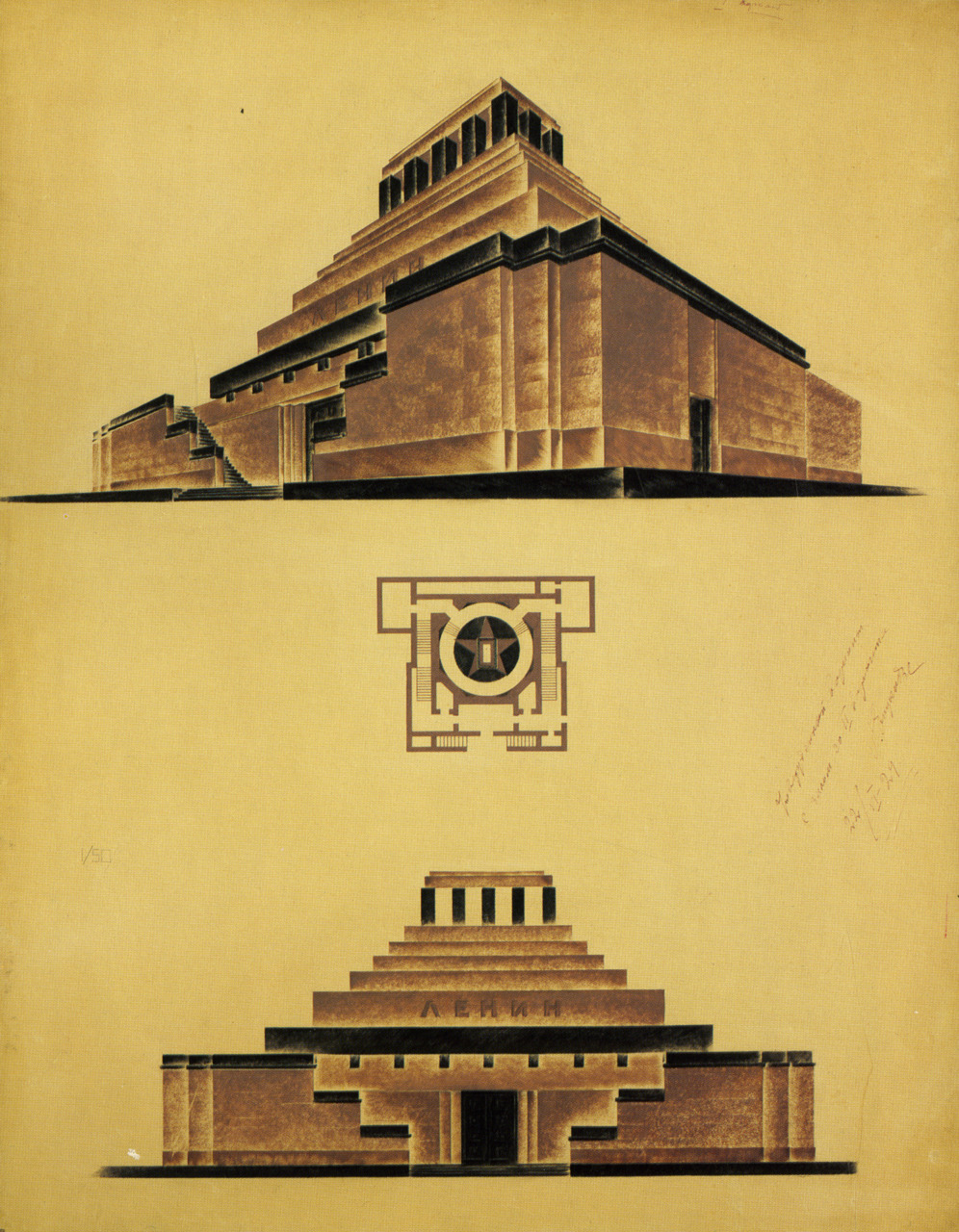
The instance of the mausoleum is of particular interest and in the case of Lenin’s it might even give us a hint as to the specificity of the modernist-authoritarians relationship to the sacred: the monument is individual in that it only celebrates one dead, whereas the awkward equivalent in our western democracies would either celebrate the abstracted heroe (The Unknown Soldier) or the collective (Cenotaphs). In both cases however, the paradoxical relationship, in modern societies, between the mourner and the mourned is one of a crowd claiming an personal, emotional, rather than ritualised or social relationship with the mourner. The ability for the "symbol" (Lenin, the Unknown Soldier) to sustain such intransigent connections with such a large amount of people might well participate to divinize him. 

Renato Nicolodi - Atrium I


"Fourth principle. Heterotopias are most often linked to slices in time - which 
is to say that they open onto what might be termed, for the sake of symmetry, 
heterochronies.The heterotopia begins to function at full capacity when men arrive 
at a sort of absolute break with their traditional time."

Michel Foucault, Of Other Spaces, 1967

When in The Total Art of Stalinism, Boris Groys describe the Avant Garde and the Socialist Realist art as both attempting at establishing themselves in an extrahistorical space, he does not address, maybe because it is so obvious, the shared monumentality of the two discussably opposite movements: Monuments are more than anything else Heterotopias of Time, they exist chiefly as a testament from the past to the future, a testament from an idealised past to an imaginary future. In that regard they deny the present but not the individual. The personal experience of the visitor is purely turned towards the past (memorials) or the future (the project) negotiating through the audience’s experience a unity between the contemporaneity and the mythical time. To achieve this the monument needs complete contemporaneity, that is no trace of quotes or composite aesthetics, a tension or paradoxe eminently exposed in Stefan Hoenerloh's paintings
The example selected for this type of Heterotopias is the library - this is obviously reminiscent of Borges Library of Babel, that is so monumental in it's proportion, that it is constituted of an indefinite or perhaps infinite repetition of the same space. Repetition is a characteristic of both the sacred and the industrialized, a feature I have come to consider as playing an essential part in modernist aesthetics, because in it's multitude, it isolate the object as a signifier. This is peculiarly obvious in Erik Desmazieres Escher-like illustrations (as shown here on the awesome blog of the awesome illustrator John Coultart) or the (less convincing) Michelle Lord "City of the Immortal" project. 
Unsurprisingly, Foucault’s 1964 lecture starts out on the fundamental duality of space and time, relating at time “anxiety of our era” to the overwhelming concern for space. The monumental could be seen as either confirming or countering this view: denying it as it expresses an urgent preocupation with time, and confirming it in it’s expression of this concern in terms of space.


Renato Nicolodi - Atrium I

...

"Looking back at the ruins of the twentieth century, we see more paradoxical mergers: between suprahuman state models and human practices, between individual aspirations and collective pressure, between ascending dreams and down-to-earth everyday survivals."

Svetlana Boym, Tatlin, or, Ruinophilia, 2007


Renato Nicolodi - Personal Museum II

The scale of Nicolodi's art works certainly participates of displacing them definitely from the space of the collective into the space of the individual: the ritual value is withdrawn and from an environment, the monument becomes an object, if not a tool. Whereas the environment in the ritual is meant t to manifest the limits, the duty or tradition, the tool itself is empowering, it is the conductor of action, and of symbolic action, by which the participant can interact with the tradition by either perpetuating it or transgressing it. 

Renato Nicolodi - Personal Museum II

This shift in the balance of power might transform the ritual from an oppressive method of enforcing the statu quo into an individualistic self assertion, making him into if maybe not a Demiurge in the sense of Boris Groys, at least a entity on the level of collective or impersonal ones, and his own decision as national interest. 

Renato Nicolodi - Personal Museum II


Saturday, 31 March 2012

The Austere Beauty of Mathematics

"Where there is numbers there is beauty"

Proclus

Ernst Haeckel - Acanthophracta / Michael Hansmayer Studio - Tetrahedron / Platonic Solids - Tetrahedron


Ernst Haeckel - Polycittaria / Michael Hansmayer Studio - Dodecahedron / Platonic Solids - Dodecahedron


Ernst Haeckel - Phaeodaria / Michael Hansmayer Studio - Hexaedron / Platonic Solids - Hexaedron

Ernst Haeckel, famed for being an early and major advocate of Darwin's theory, was an important biologist and proto-geneticist who is nowadays mainly remembered for his book Kunstformen der Natur, extremely accurate hand drawings of several hundred of species, most of them observed through a microscope. The book was intended to reflect a worldview and his own interpretation of evolution, and went on to become a major influence (some say the defining influence alongside Beardsley-style japonism) onto Art Nouveau. Many of the species he discovered (Radiolaria) are notable for their perfect polyhedral structures.


Michael Hansmeyer's Zurich based studio specializes in computational architecture, which in this case seems to mean essentially fractal generative modelisations. The particular series presented here, Subdvivisons: Platonic Solids, answers the traditional assumption that architecture consist in a permutation of the primitive solids: the fundamental "building blocks" of reality, or at least of classical aesthetics, are submitted to a single algorithm that develops it fractally towards infinitely complex forms. 


According to Proclus, platonic solids were discovered by Pythagoras, although archaeology have proven him wrong - Pythagoreans believed in the absolute reality of numbers and therefore were likely to hold the solids as manifestation of the essence of reality, while Plato associated them in the Timaeus with the four elements constituting the material world. 


"Mathematics, rightly viewed, possesses not only truth, but supreme beauty — a beauty cold and austere, like that of sculpture, without appeal to any part of our weaker nature, without the gorgeous trappings of painting or music, yet sublimely pure, and capable of a stern perfection such as only the greatest art can show. The true spirit of delight, the exaltation, the sense of being more than Man, which is the touchstone of the highest excellence, is to be found in mathematics as surely as poetry"

Bertrand Rusell