1

Showing posts with label Art. Show all posts

Monday, 16 March 2015

Number, Measure, and Law

"We need number, measure, and law as armor and as a weapon, lest we be swallowed up by chaos."
Oskar Schlemmer, Perspektiven, 1932
quoted by Beau H Rhee

Koloman Moser - Flower basket S 781 - 1906

Giuseppe Terragni - Casa del Fascio - Como - 1932

Sol Lewitt - 21B - 1989
via Archive of Affinities

Monday, 25 November 2013

Like a small photograph - Peter Behrens

Art is the performance of the cosmic drama in which by means of pictures as symbols the cosmic event is shown in deep convincing acts. The cosmic story, the cosmic drama, the cosmic statue, the cosmic painting, the cosmic building, in short, the harmony, the whole cosmos put together in one aspect, like a small photograph which shows the whole scene.
J.L.M. Lauweriks, Het nut en doel der kunst, in Theosophia, 1907
Quoted in and translated by F.G. Evelein, “‘Pure Theosophical art.’ cosmogenesis, cosmic consciousness and evolution.” 
Paper presented at the Society of Architectural Historians Annual Meeting, April 1996, via Susan R. Henderson 


Peter Behrens - Crematorium - Hagen - 1906/1907

Peter Behrens - Crematorium - Hagen - 1906/1907

Peter Behrens - Crematorium - Hagen - 1906/1907

Saturday, 6 April 2013

Technology reaching it's fulfillement - Charles Sheeler

"Wherever technology reaches its real fulfillment, 
it transcends into architecture."
Mies van der RoheBlackstone Hotel Speech on April 17, 1950


Charles Sheeler - The Upper Deck - 1929

Charles Sheeler - Water - 1945

Charles Sheeler - Golden Gate - 1955


"Any sufficiently advanced technology 
is indistinguishable from magic"
Arthur C. Clarke, Hazards of Prophecy: The Failure of Imagination, 1962

Friday, 29 March 2013

Modernism and Fascism: The Sense of a New Beginning under Mussolini and Hitler


'O man-projected Figure, of late 
Imaged as we, thy knell who shall survive? 
Whence came it we were tempted to create 
One whom we can no longer keep alive? "
Thomas Hardy, God's Funeral, 1908, in A. N. Wilson's God's Funeral


If you wonder whether or not you should buy this book, I will try to save you time: go and buy it now, read it first and maybe later come and read this post. In the following paragraphs I might appear more critical of the work than I actually mean to be, and that is only for a couple of reasons: first, reading -and writing- a review that has only praises to share is fairly boring, and second, criticism of such a dense and structured theory prompts, as it should, the groping development of my own ideas, and provide me with a platform to put them in form. 
When Stanley G. Payne writes this book is 'the most important to appear in the history of fascism in a decade or more' I think it is not only to keep his seat in the canonical assembly of the New Consensus, but because this is truly a step forward for his field both in terms of method and of content, a big step on the slippery slope of fascism studies that could have proven fatal to anyone less rigorous, well read and well established than Roger Griffin.


Roger Griffin has published four books, a collection of essays, edited a number of key sources in the area and, Iordachi tells us, written more than a hundred articles. In the process he largely engineered the emergence of a "new consensus" in the field of comparative fascism studies, essentially a definition and interpretation of fascism as an international phenomenon, including both Nazism and Italian Fascism, as well as number of other more or less embryonic related movements throughout the world, stretching from the early XXth century to contemporary examples. 

If you would like a better grasp of the notion, and how he differentiates it from previous accounts of the fascist phenomenon, you will find him unpacking his concept time and again, and summing up the state of scholarly research in the field (here for example) both online and offline - but for the time being, let us focus on the more condensed definition he provides, in its more concise incarnation: 

"Palingenetic Ultranationalism" he finds to capture the essence of the phenomenon, iin somewhat sibylline terms. But Griffin leaves nothing to chance and repeatedly proceeds to explore the meanings of both terms with great skills and minute precision; To keep it short one could define ultranationalism as a form of authoritarian and often violent concern with homogeneity - both ideological and biological - "palingenetic," on the other hand, present a bigger challenge, but also the true specificity of Griffin's interpretation, for it refers to fascism's alleged irrational, mythic and 'political religious' content, an area difficult enough to grapple with for historians already treading a narrow path, to the point it had often before been belittled or completely ignored. 

Palingenesis, more specifically, refers to the quest of (national) rebirth, that New Beginning the subtitle of the book refer to; And indeed, Modernism and Fascism, more than any of his previous books is partly abstracted in order to focus on concepts, and on palingenesis in particular, an elusive notion which Griffin confronts with an extended arsenal of concepts often lifted from studies of modernity and modernism, ranging from Zygmunt Bauman to Modris Eckstein, but also Frank Kernode or, as we will see, Victor Turner. This makes for a rather different book from what his readers might have been used to, stretching defiantly his field of expertise. Save the two central examinations of modernism in Nazi Germany and Fascist Italy, do not expect the dense, focused, surgical prose one finds elsewhere in his work: this is an ambitious work of theory, of 'reflexive narrative' as the author calls - and as ambitious his endeavour, it worked for me on at least two levels: both in providing a compelling and original analysis, and on introducing me to a entire range of sources and concepts carefully handpicked across many unfamiliar disciplines.  

I suspect an emerging trend of historians calling onto anthropological concepts to untangle difficult notions the 'post-modern' approach did not provide for (just yesterday I heard UCL David D'avray make a similar case.) Here and there they might be found raving defiantly against the Cultural Turn lobby, but it's armed with a precise conceptual apparatus (his signature Weberian 'ideal type' or the 'reflexive narrative') borrowed from very respectable authorities that Griffin sets out on the Grand Projet to provide his readership with an autobahn stretching from generic fascism to the roots of modernism, and even way beyond this into the age old 'psychodynamics' of mankind as a whole:

Umberto Boccionio - Fusion Of A Head And A Window - 1912 - 


"Destruam et Aedificabo"
Joseph Proudhon's motto, of contentious signification
quoted in James H. Billington's Fire in the Minds of Men


The book first attempt to produce a working definition of modernity, in anthropological terms, as a gaping hole left in the ideological fabric of the West, a 'black hole' absorbing mankind's virtus and high-minded ideals. This rotting corpse left over from God's aborted funerals exhale an angsty stench that has fueled many artistic and ideological movements since the Enlightenment. Escaping this dire metaphysical condition, Griffin's modernists experience sparse but intense epiphanic moments, timeless and overwhelming mystical experiences flowing often from Modernity's very heart, and, on the late, set out to construct a world that could render this extra-temporality permanent. 
The construction of atemporality is found to justifies the dual fascist (and modernist) imaginary, often perceived as paradoxical: futural and modernist on the one hand, arcadian, pastoral and sometimes primitive on the other.

Throughout the book he presents his reader with several compelling examples of the oft occulted relationship between modernism and fascism in art and design, from which, for example, I borrowed here. As confirmed by the rich bibliography he provides, the association of fascism with modernism is not as rare he sometimes make it out to be: the real and riskier thesis of his book lies elsewhere, namely in the atavistic interpretation of modernism itself, as the cultural dynamic that spawned and sustained fascism.
Modernism is a movement, loosely defined and certainly blurry on the edges, but none the less recognizable - where it becomes problematic is in identifying it's source and it's logic, since it is undeniably bound up to modernity, not unlike fascism itself: either through conscious identification, or as hostile reaction. Griffin attempts to outline an image of programmatic modernism that transcends the modernist/reactionary duality, but it sometimes feels like somewhat of a pragmatic reaction, attempting by the means of modernity to reconstruct a pre-modern ideal. In order to encompass the cultural pessimism admittedly axial to any interpretation of the development of fascism, Griffin I believe favours the second interpretation, that of modernism being a reaction, to modernity, and to that pervasive 'low-brow' form of secularization Weber coined the 'disenchantment of the world'. 

If modernism was often elusive a concept, modernity is one broad behemoth of a notion, that feels sometimes like it has been misplaced, like belonging to the 'theology shelf' rather than the 'sociology' or 'history' one: to put it differently, modernity might well have drained the world from much magic, but this only made modernity all the more numinous; 
For Griffin's fascists, modernity has robbed the West of it's certainties, of it's meaning and of it's purpose: deprived from an integrated, coherent and self-contained representation of the world, man cannot ward off any longer the ever-present existential terror inherent to his condition as a sentient being. Modernism, the author finds to be a nebula of attempted solutions to this spiritual crisis, particularly acute under the raging capitalism of XIXth century Europe. It manifests itself either in epiphanic form (essentially the contemplation of this numinous modernity I referred to earlier), or, more importantly for the subject of the book, in programmatic fashion, that is as an organized attempt at constructing wholly a re-enchanted world, to forge anew the 'Great Chain of Being' with which to fetter anew the world as it stands.
This is what Griffin calls political modernism, a concept that we could to define away from the ageing tropes of totalitarianism so as to integrate Zionism for example, or democratic nationalism in the colonies. In my eyes this notion, if indirectly treated, appear to be one of the cores of the book's many headed hydra, and it is easy to picture how comparative analysis of political modernism might bring crucial new concepts to the table. 
The other core concept I think is the characterization of fascism as essentially modernist - but a modernism that is not merely an isolated, self-conscious and indulgent aesthetic aping, but a 'primordial', universal and heartfelt reaction to an existential condition. This approach the author wants to be a solution to the perceived "aporias" of fascism, as resolving the paradoxes that have now for decades eluded or polarized scholarship.

This is a courageous stand point, the polar opposite of the still often encountered pathologisation of fascism, and if it by no means justifies or sympathizes with fascist ideology, it also ensures to keep at bay any assertions of fascism's "exceptionalism", in it's psychological or sociological forms. 
As to the resolution of fascism's paradoxes, I am maybe less convinced, as I have come to think of at least some fascist thinkers  as self-consciously, -perversely, even- paradoxical (NR in particular, but also cultural pessimists/traditionalists, and some of the artistic 'fellow travelers', all of which hold a preponderent position in Griffin's narrative). In his interpretation, the modernist, utopian drive, essentially pictures a sort of palingenetic Progress as transcending time to bring about a world where physical and cultural technology has largely been abstracted. This, to me, fails to address to it's full extent fascism's refusal of progress, and their embrace of paradox as transcendence  This would take into account the instrumentalisation of anti-enlightenment thinkers (Joseph de Maistre etc.) of many fascist or proto-fascist movements (for example Action Française) and the theological elements sometimes construed as rhetorical. 

The modernist and fascist peculiar fusion of utopian and arcadian imaginaries is not fully explained by their alleged striving for an extra-temporal, permanent civilization: anarcho-primitivists (by no means fascists!) for example offer an often immanent understanding of the future as a new past. In their case, as, I believe, in some manifestations of fascist (often volkish) thought, it is not progress that is understood to abstract from contemporary existence an idyllic pastoral, but it's very refusal, an epoch-making process not of innovation but of brutal regression. 

Caspar David Friedrich, Zwei Männer am Meer, 1817

"Wie scheint doch alles Werdende so krank"
Georg Trakl, quoted by Theodor Adorno in
Spengler nach dem Untergang, 1950

Anthropology sometimes reminds me of political theology: in Carl Schmitt's often quoted "All significant concepts of the modern theory of the state are secularized theological concepts not only because of their historical development - in which they were transferred from theology to the theory of the state, whereby, for example, the omnipotent god became the omnipotent lawgiver," one can discern the same concern with distinguishing (or establishing) a permanent order of social relations, and an integrated model of both inner and social life.
Anthropology, though, for all it's concern with tribal societies, wrestle heroically a model of change, of transformation, whereas Schmitt, Evola or even at some extent Eliades, are in search of permanence to legitimize their own modern existences, or that of particular regimes.
What Griffin's interpretation, to my surprise, does not take into account, something central to my intuition as to fascist reflexivity, is the understanding of modernity as being essentially irremediable, permanent - In the fascist spectacle, the predominance of style, as is sometimes argued, evidence acute awareness of the sheer infeasability of its project, and fully embrace the subsequent tragedy. It does not so much attempt at re-enchanting the world, as it pretends it does: the true blackness and nihilism of the fascist movement is to be found in this half-acknowledged awareness of the futility, and hence ultimately of it's mere aesthetic character, of attempting any resistance in the face of modernity, 

Griffin here and there throughout the book shows he is quite aware of the uncannily parallel trajectory an historian is bound to follow when attempting to evidence (or to conjecture) the peculiar mindset that would have presided to the development of fascism: his own narrative of this emergence, in all it’s sweeping ‘trandisciplinarity’ and reflexive essentialism, is not without analogy with the very ludic recombination, he elsewhere found to characterize the autodidact intellectuals of the New Right. Sternhell, I hear, was often to be found on the shelves of NR and radical right, but I would not be surprised would his historical work soon come to be dwarfed by Griffin's volume.
This in and of itself does not strike me as problematic in the least, but if the outcome of an informed research work by the leading scholar in the field produce an ideological map so similar to that followed by the alleged fascists themselves, we might need to add on that map some sort of indication as to this peculiar fascist self-consciousness:

Victor Turner, whom I have before mentioned in the context of the ludic metaphore, provides Griffin with the master-key to his 'primordial' interpretation of fascism and modernism interrelations: Turner, an anthropologist (famed for his advocacy of performance studies, and a close collaborator of Richard Schechner) is often remembered for his compelling interpretation of ritual and performance interrelations. 

But what Griffin lifts from Turner's vast analytical framework is a less popular assemblage, a universal typology of crisis. Turner's theory advances that every institutional response to transgressions or conflict, be it in modern or pre-modern societies, takes place in  a peculiar isolated space and time, a land of symbols and rituals both escaping the routine and crucial in maintaining it. Crucially, this enclave Turner finds to act as the 'reservoir' of social and cultural change, providing both a framework and a justification for innovation and adaptation. 
In Turner's model, when a society experience a crisis that requires change, it is often unable to effect those changes itself in it's day to day process - it needs to call for the delimitation of a special time and place, somehow situated outside of the normative boundaries of tradition, a spatio-temporal state of exception if you will, where structural changes and innovation that would elsewhere be perceived as hostile, are allowed to take place. This space and time, that of rituals but also of organized justice, is what Griffin and Turner refer to as the liminal (when it aims at perpetuating the existing order) or liminoid (when it attempts at creating a new one.)


Unknown - Yesterday and Today - 1925


Theatre is, indeed, a hypertrophy, an exageration, of jural and ritual processes; 
it is not a simple replication of the “natural” total processual pattern of social drama. 
There is, therefore, in theatre something of the investigative, judgemental, 
and even punitive character of law in action, and something of the sacred, mythic, numinous, 
even “supernatural” character of religion action – sometimes to the point of sacrifice.” 

Victor Turner, From Ritual to Theatre: The Human Seriousness of Play, 1982


Griffin sizes the well formed anthropological model as the core of his reflexive narrative of modernity - modernity becomes an extended, permanent sense of crisis, and modernism's ritual and symbolic agitation an attempt at harnessing the power of the liminoid to put an end to the modern condition.
One is bound to agree that all consideration of such titanic concepts as modernity could hardly be pursued without a narrative of sort - yet as Griffin selected, from the gigantic interconnected body of work proposed by Victor Turner (stretching from such universal conceptions as Social Drama, all the way to performative praxis of rituals in school - which in Griffin case's would admittedly be taking "methodological empathy" a step too far!) one is surprised to find he leaves out Turner's emphasis on the relation between reflexivity and performance: in ‘From Ritual to Theatre: The Human Seriousness of Play”, he for example advances the existence of a continuum stretching between ritual, a true ‘ideal type’ lost in the midst of conjectural history, and theatre or performance, reflexive and modern. 

Griffin is well aware of the collusion between modernist theatre and political praxis (see his ‘Staging the Nation’s Rebirth' or his quoting from Falasca-Zamponi) - but to my surprise, the model through which the author analyses and deconstruct both fascism and modernism gives surprisingly little credence to the development of this reflexivity: whereas he is at pains to insist on the legitimizing presence of the said reflexivity in his own narrative interpretation of modernity, in modernism and fascism, it seems that for all his methodological empathy, he did not find in the fascist train of thought, nor, more surprisingly, in the the modernist one either, enough self-awareness to address nor question the ritual pattern, the ‘eternal return’ of an atavistic concern allegedly transcending time. Reasons and excuses abound when looking at the existing scope (and size!) of the book as it is written – but I cannot help but think that, for example, the Benjaminian debate over fascism manifesting the aesthetization / sacralisation of politics would be seen under a different light if modernism, political or otherwise, came to be interpreted as a spectacular and performative (if not downright parodic) re-enactment of a fabled, yet total and coherent golden-age.

But let's be honest: I am pretty glad he left that much out, because as those who will or have read the book might notice, there is little on this blog that could pass as anything else than a paraphrase of Pr. Griffin in general, and of this one book in particular! 

Saturday, 29 December 2012

The Ladder of Civilization

"by the mere fact that he forms part of an organised crowd, 
a man descends several rungs in the ladder of civilization. 
Isolated, he may be a cultivated individual; in a crowd he is a barbarian - 
that is, a creature acting by instinct."
Gustave Lebon, La Psychologie des Foules, 1895


Enguerrand Quarton - Detail from Le Courronement de la Vierge - 1453-54

L. S. Lowry - Our Town - 1943

Bernard Buffet - L’enterrement - 1949

Wednesday, 12 December 2012

Nor the splendor of time - Antony Gormley, Model

"But what is it that I love in loving thee? Not physical beauty, nor the splendor of time, 
nor the radiance of the light -so pleasant to our eyes- nor the sweet melodies of the various 
kinds of songs, nor the fragrant smell of flowers and ointments and spices; not manna and honey, 
not the limbs embraced in physical love -it is not these I love when I love my God. 
Yet it is true that I love a certain kind of light and sound and fragrance 
and food and embrace in loving my God, who is the light and sound and fragrance 
and food and embracement of my inner man"
Saint Augustine, The Confessions, Book X, Chapter 6


The Antony Gormley "Model" exhibition at the White Cube gallery runs from the 28th of November to the 10th of February. Most of the opinions ascribed to the artist where expressed at his discussion with Tim Marlow on the 12th of December 2012. 


Theo Van Doesburg - Study for rhythm of a russian dance - 1918


Antony Gormley's career echoes masterfully many of the concerns I have so far displayed on this blog: his work address what has been described as a return to modernity, but a re-constructed modernity, largely freed from it's inbuilt contradictions, from it's ruthless violence and it's teenage angst, leaving only the poetics of reason and the mystique of abstraction. 
Gormley is not alone in this pursuit, but whether him or the others are genuinely moved by the crushing ideals of high modernism, or whether they are content to re-enact those glory days as an heroic (if futile) last stand against the post-modern wasteland, I cannot tell. In either case they have my sympathy. 


Antony Gormley - Transfuser - 2002


Gormley's sculpture addresses many of the "traditional" themes of monolithic modernity: the multitude, harmony, abstraction, or proportions, but generally through the conceptual lens of the human body, which seems to provide him with a permanent referential around which to build his rational aesthetics. 
His new show continues in this vein, exploring the body as a space we inhabit. 

The entire exhibition is an aggregation of rectangular cuboids, in different materials (from corten to polystyrene  via wood, cast metal and plastic) and in a variety of scale, from the toy soldier to the pavillon. 
We can identify three parts to the exhibition, three main scales of work: the smaller works are all to be found in one room, which seem essentially to document the conceptual and technical process that brought us the larger works. The process in question is essentially one of abstraction, where the human body, it's shapes and it's proportions, is gradually simplified into a combination of angular boxes, much reminiscent, in it's later stages,  of Malevitch' Architekton


Antony Gormley - Mark - 2012


The medium scale is one more or less consistent with actual human proportions: what at first appear like an abstract accumulation of blocks reveal, at closer inspection, human bodies, playfully disposed in natural, and not so natural positions, around the gallery space, like so many dancers frozen into intimate performances, but boxed, reduced to the space they occupy. 

The third scale, and judging from the talk given by the artist, the central work, is a rather gigantic construction of metal sheets which the visitor is first invited to circle, to study as a gigantic sculpture, before being invited, like Job, to enter in a Hobbesian Leviathan. 

Perambulating inside the controlled space proves to be as compelling an experience as promised by the artist: the complex interplay of surfaces, planes and light make for many surprising vistas and interactions, prompting intense experiences mixing claustrophobia, disorientation and exploration; Like a concrete presentation of St Theresa's Interior Castle we visit a space so stripped of signification that we can project our elusive, innermost realities onto it. 


Antony Gormley - Model - 2012


Space and architecture as a metaphor for inner life is itself an important modern concept (as described by Frances Yates)  and Gormley is fond of colliding this subjective, intimate construction of psychological architecture with the harsh, brutal(ist) materiality of the world he constructs - his rhetoric allies the pervasive abstraction of mystique and Platonism with the materiality sculpture as an exploration of space. The modern meet the modernist. But ultimately his work seems to address the power of the metaphor, organic and spatial. 
The exhibition is compelling on more than one ground: for it's stretching of the boundaries of the gallery experience, as one has come to expect from international artists, but also for his very refined take on modernity, whose latent mystic and spirituality will hopefully take part in shaping the supposed revival of modernism. 


Antony Gormley - Model - 2012


Yet this very mystique can also leave one wanting: If Le Corbusier's houses were machines to live in, what is the purpose of Gormley's? The new modernist paradigm seems keen to conciliate art for art sake with pure contemplation, and when Gormley characterizes his work as a tool, as "machine" one is tempted to say, he remains elusive as to its purpose: oceanic feelings, self-exploration, or inverted allegories of the cave all sound very much contemplative in essence. 
Contemplation is an activity essentially solitary, inward and subjective, even leaving little room for the contradictory maelstrom of opinions and ideals the modern culture cater to. The very elusiveness of the absolute the artist seems to invite us to pursue leaves a gaping void in both his work and his theory, which one can only wonder at. If modernism is to be revived in all it's claims of purity and high-mindedness, not only as a style or a facade, but as a genuine, heartfelt ideal, surely tolerance, accessibility and marketability will have to make room for an absolute, transcendent telos that will suffer no contradiction.


Oskar Schlemmer - Illustration for "Man and Art Figure" - in Theater of the Bauhaus - 1925

Thursday, 22 November 2012

The Sense of Wonder

"The suddenness, radical disorientation, the sensation to be withdrawn from the normal course of time, 
the intuitive certitude to have come in contact with a real ordinarily hidden, 
the overwhelming joy, the serenity, the sense of wonder.
Michel Hulin, La Mystique Sauvage: Aux Antipodes de l'Esprit, translation mine. 

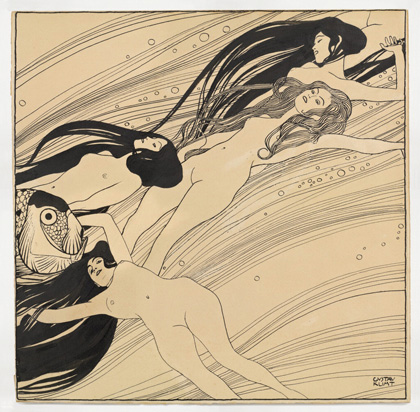
Gustav Klimt - Fish Blood - 1897-98

Jan Toorop - Fatalism - 1893

Kasimir Malevich - The Shroud of Christ - 1908

Thursday, 8 November 2012

The Second Time as Farce

"Hegel remarks somewhere that all great world-historic facts and personages appear, 
so to speak, twice. He forgot to add: 
the first time as tragedy, the second time as farce."
Karl Marx, The Eighteenth Brumaire of Louis Bonaparte, 1852


Kasimir Malevich - Suprematism (?) - 1915

Blue Noses - Kitchen Suprematism - 2005

Frank O. Gehry - Winton Guest House - 1983 to 1986

Wednesday, 7 November 2012

Mathew Borrett - Dwelling of the Gods

Therefore we ought to try to escape from earth to the dwelling of the gods as quickly as we can; 
and to escape is to become like God, so far as this is possible.” 
PlatoThaeatetus


Mathew Borrett - Exploring a Hypnagogic City


Mathew Borrett - Hiding Places


Mathew Borrett - Sleeping With The Window Open


Mathew Borrett - Some Memories Are Flooded

Mathew Borrett - Untitled

Tuesday, 14 August 2012

Where form can be formless

"To us today there is no doubt that Greek artis an insistence that the sense of exaltation is to be found in perfect form, that exaltation is the same as ideal sensibility, in contrast, for examle, with the Gothic or Baroque, in which the sublime consists of a desire to destroy form, where form can be formless."
Barnett Newman, The Sublime is Now, 1948


Gustave Courbet - Bord de mer à Palavas - 1868

Barnett Newmann - Untitled (Stations of the Cross) - 1946 (?) sideways

Yuu Sakai - Untitled (via Minimal Exposition)

Erik Bulatov - Horizon - 1971/72 (via artdaily)

"A culture is born in the moment when a great soul awakens out of the protospirituality of 
ever-childish humanity and detaches itself, a form from the formless, a bounded and mortal 
thing from the boundless and enduring."
Oswald Spengler, The Decline of the West, 1918

Sunday, 29 July 2012

Karel Teige - Dancing About Architecture

Writing about music is like dancing about architecture” 
Frank Zappa
(Or was it Elvis Costello?)

Karel Teige - Untitled - 1947


Karel Teige - collage #25 - 1936


Karel Teige and Jaroslav Rössler - Les Mamelles De Tyresias - 1926


Monday, 23 July 2012

City of the Sun

We have been jumping into the future since 1905” 
Khlebnikov in a letter to Burliuk in 1915, reported by Vladimir Markov, Russian Futurism: A History, p. 157


Ivan Leonidov - City of the Sun - 1943

NASA / Reuters - Venus passing in front of the Sun - 06.06.2012


Saturday, 21 July 2012

Haus-Rucker-Co. - The Epoch of Space


"We are living in the rococo of modernism today"
Peter Eisenmann

The good people at WORK Gallery in Kings Cross often host exhibitions presenting exciting contemporary artists involved in political and radical practices - but their latest exhibition, no less exciting for all interested in Utopias and counter-culture, is dedicated to the work of Austrian architectural collective Haus-Rucker-Co. Composed of Laurids and Manfred Ortner, Gunter Zamp Kelp and Klaus Pinter, they gained international attention between the late sixties and the early eighties, proposing daring interpretations of the urban landscape in a number of temporary installations ("Provisional Structures") in various cities and gallery space. They also produced a large amount of paper architecture - a field, you might have gathered, of particular interest to this blog. 
The exhibition runs until the first of September and sample a variety of projects spanning over their entire production, from furniture to full size buildings - all richly documented through a variety of pictures, sketches, collages and models: 
Organic shapes, synthetic materials, sensual futures, pea coats and mustaches: what Haus-Rucker-Co, has been known for on the blogosphere is well represented but are also treated to a unique insight in the theory and the concepts that sustained their projects. 


Haus-Rucker-Co. - Environement Transformers - 1968


The Space Age was not all Sputnik and The Jetsons: it also brought more theoritical investigation of space. Not, this time, as a liminal world where the grown man's impatient imagination could roam free, but the ambiguous environement where physicality meets cultures and practices - the space of Fontana's actions, of Foucault's geography and of Lefebvre's justice.


"The great obcession of the nineteenth century was, as we know, history (...) The present epoch will perhaps be above all the epoch of space."
Michel Foucault, Of Other Spaces, 1967


The epoch of the Space Age future was to be an epoch of space; Freed from the contingency of history, freed from the guilt and the responsabilities, the architect was at last allowed to experiment for experimentation's sake: "Its design is free from local politics and utilitarian pressure because provisional architecture is not burdened with the mortgage of having to sustain the next hundred years" says Laurids Ortner, one of the founding members of the collective.
And indeed, the idea of provisional structures, constructions that are designed and produce to last a limited period, addresses directly this primacy of space over time: whereas architecture until then, more openly than any other field of design, seemed to be concerned with history or it's rejection, here it may have found in ephemerality it's full avant-garde realization. 
On the contrary, interrogations about space become central, and of public space in particular. Spaces of interaction, of exchange, where social life potentially enters the realm of the experimental:


"Within urban areas 'naturally grown' provisional structures have already shaped the general appearance to a large degree: the 'every day' architecture of traffic lights, add-paintings, traffic signs, masts and wiring has long since overcome classical architecture."
Laurids Ortner 


Indeed a lot of the Austrians work is concerned with urban, common space, it's use and it's appropriation - certainly the most obviously political element in their practice. Many of their works, treading the thin line between public and private spheres, would address in Jurgen Habermas words, our relationship to the other, but also to the sphere of public authority.
The experiments of the group in soft structures, modular architecture and transparent surfaces are indicative enough of their expectations, whereas later works like Insel Hamburg, Schrage Ebene or Wellenweise hint at their oblique strategies, and interrogations concerning the inclusiveness and the delimination role of architecture.


"The construction of voluminous changing shapes from a moving malleable substance."
Manifesto Blanco, 1946


Haus-Rucker-Co. - Gelbes Herz - 1968


Space Age has pretty much disappeared, relegated to the backlands of quirky furniture and retro hype - every once in a while we see it resurfacing in a film or collection, recently in it's soviet flavour in particular (Kosmograd, Post-gravity Art, CCCP, etc.) 
Conceptions of the future have evolved a lot throughout history and often provide quite peculiar evocations of the zeitgeist: Futurism, we will see, was an obvious forerunner, and if it's fanatical devotion to mass media brings it closer to the Space Age populist strategy, it's brutal avant-gardism still leaves it miles away from Twiggy and Mary Quant's child-like optimism:
The 1960s Space Age was rooted not, as for the Italian Futurists, in that metaphysical experience of the mechanized war machine, but in an other type of machine: one pointed to the stars, in a collective effort to propulsing the human body beyond the sky, into this abstract and minimalism empyrean kingdom were life was so alien that functionalism itself could look exotic, reconciling in the process pop culture's demand for spectacular with high-modernism. 
The conquest of space certainly brought about the near mystique optimism in the potency of human thought, but in parallel the western world's economy was settling into a new paradigm, seeing the parallel rise of youth culture and leisure society: the complex interactions between these two concepts will determine large chunks of both the mainstream to come, and the vociferous Marxist counter-culture:


"Should a man wander through the city and see through the busy but aimless throngs, 
consuming themselves, he would be amazed
Robert Chasse, Hall of Mirrors, Council for the Liberation of Daily Life, 1967


A number of pieces of Haus-Rucker-Co. presented in the exhibition address questions of environmentalism (like "Grune Lunge" or "Natur Inszenierung") and the space occupied by nature in the city: the entire "Berg in der Stadt" proposal (1973-74) suggest the construction of large facades of fake mountainous surfaces, mounted on a metallic skeleton, simulating from one side a slice of raw, natural landscape, and displaying on the other the full artificiality of it's construction. 
Here there is a clear departure from the polished and industrialized aesthetics of the Space Age: in exposing the underlying structure, architecture is changed from a commodity to a process. William Kent, who is credited for inventing the English garden, created vast enclaves of tightly controlled nature, paradoxically mimicking the natural landscape as it can be found outside of gardens. Yet throughout his pastures one can find ruins, fake obviously, but as carefully aged and deconstructed as his garden were skillfully overgrown. The ruins, he said, were a pivotal element, as they were to be the sole indicator of the presence of man, stressing how much work and thought went in the design of those modern arcadias. Maybe it is under this light that one should see the structures proposed by Haus-Rucker-Co. : as many displays of artifical nature, be it an oasis or a mountain, to remind the city-dweller of the skills and perfection of nature that went into the creation of our cities. 


Haus-Rucker-Co. - Palmtree Island, Downtown Megastructure & Environement Transformers - 1971


"provisional architecture is agressive. It breaks up burnt-in habits of seeing.
Laurids Ortner


Many of their projects address classical tropes of the modernist to post-modernist turning point:  the hidden is made apparent, the structure become external and the artifice, the technicality becomes part of the overall aesthetics. 
There is little doubt that their work has had a decisive influence on further architecture, not on only their fellow paper architects (AntFarm, Archigram...) but also on the deconstructivist "movement" for example: the own "Uberbauung" project of hanging gardens on the roofs of Vienna partly prefigured Coop Himmelb(l)au's iconic Falkestrasse rooftop structure. 


"As if we who are accumulators and generators of movement, with all our added mechanical limbs, with all the noise and speed of our life, could live in the streets built for the needs of men four, five or six centuries ago."
Antonio Sant'Ellia, The Manifesto of Futurist Architecture, 1917


Just like googie, borax and streamline moderne, or the Italian Futurists before any of them, it seems that the eference to the future, an essentially imagined space, place them at the edge of modernity: planning and optimism, central to modernist urbanism and superstructures, retain it's pragmatic credentials as long as projection in the future is presented as idealism - when the artist is perceived to take a step into fiction or speculation, he suddenly becomes guilty of arbitrary indulgence. 

 
"Technological achievements of our time are way ahead of our physical and intellectual development. We are human beings of the eighteenth century and have to live in an environment of the twentieth and twenty-first century.
Laurids Ortner
 

Haus-Rucker-Co. - Mind Expanders - 1967


Not withstanding their shared fascination for the machine, one key difference between the Space Age aesthetics and Italian Futurism is their respective relationship to the body: the fifty years that separate the two movements left their mark on the new conception of the future. Whereas Marinetti was vehemently calling for the renunciation of the physical, for a transformation of the body into a machine, the 60' and Haus-Rucker-Co. in particular, on the other hand, work towards a transformation of the machine into a body. 
Of course organic shapes (Gaudi, Hundertwasser, their contemporary Werner Panton) and concepts (Kisho Kurokawa) had been in use long before: at the beginning of the XXth century, the rise of concrete had meant as much the liberation from straight lines and right angles as it had heralded the modernist rationalization. Similarly the speedy development of plastic and it's easy shaping, by way of injection or void pump, allowed further transgression of the angular and asexual models of yesteryear.
 
 
"The right angle as a principle of all rigid structures oculd be overcome without formal arbitrariness, simply through the characteristics of new materials. What possibilities! Changing a society by the fact it now finds itself in a softly flowing environement: gliding into a different way of thinking on gentle wings.
Laurids Ortner
 
 
Gelbes Herz, an blow-up structure designed for two, inflate and deflate rhythmically, imitating maybe the respiration of a living body, coming, we are told, to press it's soft synthetic interior onto the visitors at each pulsation. 
The evocative experience tell probably as much about our longings as to those of it's inventors - Whether the throbbing alcove seems like a squeaky sexual playground, like a maternal safe-space or like an isolation tank for oceanic consciousness, it is the tension between those options, placing the work miles away from the hyper-virile and brutal sexuality invoked by the Futurists and Marinetti in particular, that situate it in an ambiguous and therefore perverse sexuality. 
 
 
"Perverse as well as impersonal
Robert Venturi, Complexity and Contradiction in Architecture
 
 
Many of the group's structures (Balloon for Two, Oase no7, Gelbes Herz...) are designed to offer a sense of intimacy inside the public space: the plastic membrane isolate the visitor from the world around them, participating one can imagine, in re-appropriating the public sphere - but paradoxically, all those modules, all the spaces seemingly designed to restore human interactions in their perfected, edenic sense, are formed of mostly transparent membranes. 
This might hold one of the paradoxes of Haus-Rucker-Co. and one that spreads over the sixties and their uneasy relationship to political radicalism and utopia: their reforming ideals are unabashedly a form of spectacle. Militants are media-conscious, spirituality is communal, sexual liberation brings about commodification.
Of course Haus-Rucker-Co. is not Amon Duul II - but in crystallizing the typical tension of the age between radicalism and commodification (generally justified as a strategy of efficiency), they seem to exemplify what Eisenmann's catchy saying, "The Rococo of Modernism", always brings to my mind: a society, to use Situationist terminology, where détournement and récupération have become so deeply embedded into each other that deciding whether radicalism uses spectacle or spectacle uses radicalism is virtually impossible. 
 
 
Haus-Rucker-Co. - Cover and Balloon for Two
 
 
"Toys for adults simulating contact, contact between two people, a man and a woman, 
who experience their environement and themselves in a completely new way." 
Haus-Rucker-Co. on Vanilla Future, 1969
 
 
The very impermanence of the structures not only question their role in the urban context but also grant them a specific status: as a construct that can be removed and transported, we tend to identify the provisional structure with a tool - but in the mean time, it's artistic ambition leave it largely deprived from a practical use. The useless tool is then left with only two option: too tactile and eager for an audience participation to be a work of art, the structure aims at delivering an experience rather than a message: it's a toy, a Froebel's gift for the epoch of space. 
 
 
"Play is (...) imitation of the total human life, of the inner, secret, natural life in man and in all things. It produces, therefore, joy, freedom, satisfaction, repose within and without, peace with the world. The springs of all good rest within it and go out from it." 
Friedrich Froebel, Inventing Kindergarten
 
 
The "goals" of the Haus-Rucker-Co. structure, seems in good part to have relied on the characteristic terminology of the times: development of "psychological capacity", "exploration of the inner world" and "concentrated experience" are ludicrous psychobabble. They share this ludicrous psychobabble with an other contemporary culture of keen experimentators, psychedelics. 
The goals and the medium of the "environement transformers" and, considering it was also producing sound and light effects from the inside of it's dome, the "mind expander", are as reminiscent of Pucci's 65 fligh attendants as of the mind machines of the seventies and their low-fi hallucinogenic virtual reality. but unlike those, the construction of a space isolated from the quotidian, such as Nicolas Schoffer's Cybernetic City, or the some of Warhol's more ambitious Happenings aimed at the immersion of the audience as a group. 
What the sixties brought to this age-old dream of the Gesamtkunstwerk is a radical shift of focus from the demiurgic artist to the audience: the relationships within it, and their relationship with both the world inside and outside of the artwork. Quite characteristically the "Mind Expanders" are designed for two seaters, just like the Happenings or the Cybernetic City were intended as spaces of exchange - not only between the artist and the audience but within the audience itself, becoming what Habermas coined Offentlichkeit
When the designer aim at creating or re-organizing the social interactions of it's audience he becomes irremediably political. The space of the piece becomes a temporary autonomous zone, and the artwork becomes a utopia. 


"In strongly opposing the world of play to that of reality, and in stressing that play is essentially a side activity, the interference is drawn that any contamination by ordinary life runs the risk of corrupting and destroying its very nature.
Roger Caillois, Men, Play and Games


If, as Caillois argues, reality is likely to corrupt the world of the game, then the game itself might be, in return, able to corrupt the game of life: 
The experience of the game, and it's collective experience even more, constitutes the essence of the situationist alternative life experience. A self contained world, with it's own rules and it's own goals (if any) - both a prophetic vision of what the future could be, and an experiment on how to build it. 


"Everything that was lived has moved away into representation." 
Guy Debord, The Society of Spectacle


Not having had the chance to try out any of the mind expanding "machinery", I am allowed to remain skeptical as to the actual mind expansion this would provide: if one was particularly eager to link back Haus-Rucker-Co. to situationist ideas, one could see in the presentation of normal quotidian experiences, though the absent lense of the mind expanders and environement transformers, as a form of détournement, or even maybe as over-identification with the society of spectacle it adresses: within the particular frame provided by the helmets or the dome, that provide little if any effectual transformation to the sight of the eyes, the capitalist world is framed as what it is, a spectacle. 


"Not houses finely roofed or the stones of walls well build, nay nor canals and dockyards make the city, but men able to use their opportunity." 
Alcaeus, quoted by Donal Kagan


Many of the works of Haus-Rucker-Co. like a number of their contemporaries, attempt to re-asses our relationship to space and it's purpose: a space abstracted from history and positioned in what must have seemed at the time like a timeless future. The continuous emphasis on impermanence they saw as a key to experimentation, an unstable state where architecture is freed from it's constraints of firmness, commodity and delight. Freed from the contingencies of purpose and durability they were allowed, more than functionalist architecture and urbanism could ever dream, to re-write human relationships between themselves, but also of course, human relationship with their environment. 


"Architecture is a theatre stage setting where the leading actors are the people, and to dramatically direct the dialogue between these people and space is the technique of designing.
Kisho Kurokawa


It seems that the timely pop aesthetics that presided over many of Haus-Rucker-Co designs emphasizes, consciously or not, the playful and inconspicuous aspects of their work - "relaxation" and "changes in consciousness", for all their savoury meaninglessness, hint at a growing sentiment in the sixties: the prevalence of experience over ownership - happiness no longer a situation it is a state of mind.
Like all narratives that attempted, throughout the twentieth century to bridge the gap between style and politics, to rationalize the utopia into a historical or post-historical situation, the Space Age was bound to end up stripped off from it's militant substance and relegated to the quirky and the inconsequent. But in the case of Haus-Rucker-Co. it seems that the collective moved away from away from the kitsch early enough and stuck instead to it's Utopian ideals. 


"The architecture of pleasure lies where concept and experience of space abruptly coincide.
Bernard Tschumi, The Pleasure of Architecture