1

Showing posts with label Ritual. Show all posts

Monday, 12 March 2018

Stripped Bare

Julio Romero de Torres - Nuestra Señora de Andalucía - 1907

Carlo Socrate - Vestizione della sposa - 1934


Emanuele Cavalli - La sposa - 1934

Friday, 29 March 2013

Modernism and Fascism: The Sense of a New Beginning under Mussolini and Hitler


'O man-projected Figure, of late 
Imaged as we, thy knell who shall survive? 
Whence came it we were tempted to create 
One whom we can no longer keep alive? "
Thomas Hardy, God's Funeral, 1908, in A. N. Wilson's God's Funeral


If you wonder whether or not you should buy this book, I will try to save you time: go and buy it now, read it first and maybe later come and read this post. In the following paragraphs I might appear more critical of the work than I actually mean to be, and that is only for a couple of reasons: first, reading -and writing- a review that has only praises to share is fairly boring, and second, criticism of such a dense and structured theory prompts, as it should, the groping development of my own ideas, and provide me with a platform to put them in form. 
When Stanley G. Payne writes this book is 'the most important to appear in the history of fascism in a decade or more' I think it is not only to keep his seat in the canonical assembly of the New Consensus, but because this is truly a step forward for his field both in terms of method and of content, a big step on the slippery slope of fascism studies that could have proven fatal to anyone less rigorous, well read and well established than Roger Griffin.


Roger Griffin has published four books, a collection of essays, edited a number of key sources in the area and, Iordachi tells us, written more than a hundred articles. In the process he largely engineered the emergence of a "new consensus" in the field of comparative fascism studies, essentially a definition and interpretation of fascism as an international phenomenon, including both Nazism and Italian Fascism, as well as number of other more or less embryonic related movements throughout the world, stretching from the early XXth century to contemporary examples. 

If you would like a better grasp of the notion, and how he differentiates it from previous accounts of the fascist phenomenon, you will find him unpacking his concept time and again, and summing up the state of scholarly research in the field (here for example) both online and offline - but for the time being, let us focus on the more condensed definition he provides, in its more concise incarnation: 

"Palingenetic Ultranationalism" he finds to capture the essence of the phenomenon, iin somewhat sibylline terms. But Griffin leaves nothing to chance and repeatedly proceeds to explore the meanings of both terms with great skills and minute precision; To keep it short one could define ultranationalism as a form of authoritarian and often violent concern with homogeneity - both ideological and biological - "palingenetic," on the other hand, present a bigger challenge, but also the true specificity of Griffin's interpretation, for it refers to fascism's alleged irrational, mythic and 'political religious' content, an area difficult enough to grapple with for historians already treading a narrow path, to the point it had often before been belittled or completely ignored. 

Palingenesis, more specifically, refers to the quest of (national) rebirth, that New Beginning the subtitle of the book refer to; And indeed, Modernism and Fascism, more than any of his previous books is partly abstracted in order to focus on concepts, and on palingenesis in particular, an elusive notion which Griffin confronts with an extended arsenal of concepts often lifted from studies of modernity and modernism, ranging from Zygmunt Bauman to Modris Eckstein, but also Frank Kernode or, as we will see, Victor Turner. This makes for a rather different book from what his readers might have been used to, stretching defiantly his field of expertise. Save the two central examinations of modernism in Nazi Germany and Fascist Italy, do not expect the dense, focused, surgical prose one finds elsewhere in his work: this is an ambitious work of theory, of 'reflexive narrative' as the author calls - and as ambitious his endeavour, it worked for me on at least two levels: both in providing a compelling and original analysis, and on introducing me to a entire range of sources and concepts carefully handpicked across many unfamiliar disciplines.  

I suspect an emerging trend of historians calling onto anthropological concepts to untangle difficult notions the 'post-modern' approach did not provide for (just yesterday I heard UCL David D'avray make a similar case.) Here and there they might be found raving defiantly against the Cultural Turn lobby, but it's armed with a precise conceptual apparatus (his signature Weberian 'ideal type' or the 'reflexive narrative') borrowed from very respectable authorities that Griffin sets out on the Grand Projet to provide his readership with an autobahn stretching from generic fascism to the roots of modernism, and even way beyond this into the age old 'psychodynamics' of mankind as a whole:

Umberto Boccionio - Fusion Of A Head And A Window - 1912 - 


"Destruam et Aedificabo"
Joseph Proudhon's motto, of contentious signification
quoted in James H. Billington's Fire in the Minds of Men


The book first attempt to produce a working definition of modernity, in anthropological terms, as a gaping hole left in the ideological fabric of the West, a 'black hole' absorbing mankind's virtus and high-minded ideals. This rotting corpse left over from God's aborted funerals exhale an angsty stench that has fueled many artistic and ideological movements since the Enlightenment. Escaping this dire metaphysical condition, Griffin's modernists experience sparse but intense epiphanic moments, timeless and overwhelming mystical experiences flowing often from Modernity's very heart, and, on the late, set out to construct a world that could render this extra-temporality permanent. 
The construction of atemporality is found to justifies the dual fascist (and modernist) imaginary, often perceived as paradoxical: futural and modernist on the one hand, arcadian, pastoral and sometimes primitive on the other.

Throughout the book he presents his reader with several compelling examples of the oft occulted relationship between modernism and fascism in art and design, from which, for example, I borrowed here. As confirmed by the rich bibliography he provides, the association of fascism with modernism is not as rare he sometimes make it out to be: the real and riskier thesis of his book lies elsewhere, namely in the atavistic interpretation of modernism itself, as the cultural dynamic that spawned and sustained fascism.
Modernism is a movement, loosely defined and certainly blurry on the edges, but none the less recognizable - where it becomes problematic is in identifying it's source and it's logic, since it is undeniably bound up to modernity, not unlike fascism itself: either through conscious identification, or as hostile reaction. Griffin attempts to outline an image of programmatic modernism that transcends the modernist/reactionary duality, but it sometimes feels like somewhat of a pragmatic reaction, attempting by the means of modernity to reconstruct a pre-modern ideal. In order to encompass the cultural pessimism admittedly axial to any interpretation of the development of fascism, Griffin I believe favours the second interpretation, that of modernism being a reaction, to modernity, and to that pervasive 'low-brow' form of secularization Weber coined the 'disenchantment of the world'. 

If modernism was often elusive a concept, modernity is one broad behemoth of a notion, that feels sometimes like it has been misplaced, like belonging to the 'theology shelf' rather than the 'sociology' or 'history' one: to put it differently, modernity might well have drained the world from much magic, but this only made modernity all the more numinous; 
For Griffin's fascists, modernity has robbed the West of it's certainties, of it's meaning and of it's purpose: deprived from an integrated, coherent and self-contained representation of the world, man cannot ward off any longer the ever-present existential terror inherent to his condition as a sentient being. Modernism, the author finds to be a nebula of attempted solutions to this spiritual crisis, particularly acute under the raging capitalism of XIXth century Europe. It manifests itself either in epiphanic form (essentially the contemplation of this numinous modernity I referred to earlier), or, more importantly for the subject of the book, in programmatic fashion, that is as an organized attempt at constructing wholly a re-enchanted world, to forge anew the 'Great Chain of Being' with which to fetter anew the world as it stands.
This is what Griffin calls political modernism, a concept that we could to define away from the ageing tropes of totalitarianism so as to integrate Zionism for example, or democratic nationalism in the colonies. In my eyes this notion, if indirectly treated, appear to be one of the cores of the book's many headed hydra, and it is easy to picture how comparative analysis of political modernism might bring crucial new concepts to the table. 
The other core concept I think is the characterization of fascism as essentially modernist - but a modernism that is not merely an isolated, self-conscious and indulgent aesthetic aping, but a 'primordial', universal and heartfelt reaction to an existential condition. This approach the author wants to be a solution to the perceived "aporias" of fascism, as resolving the paradoxes that have now for decades eluded or polarized scholarship.

This is a courageous stand point, the polar opposite of the still often encountered pathologisation of fascism, and if it by no means justifies or sympathizes with fascist ideology, it also ensures to keep at bay any assertions of fascism's "exceptionalism", in it's psychological or sociological forms. 
As to the resolution of fascism's paradoxes, I am maybe less convinced, as I have come to think of at least some fascist thinkers  as self-consciously, -perversely, even- paradoxical (NR in particular, but also cultural pessimists/traditionalists, and some of the artistic 'fellow travelers', all of which hold a preponderent position in Griffin's narrative). In his interpretation, the modernist, utopian drive, essentially pictures a sort of palingenetic Progress as transcending time to bring about a world where physical and cultural technology has largely been abstracted. This, to me, fails to address to it's full extent fascism's refusal of progress, and their embrace of paradox as transcendence  This would take into account the instrumentalisation of anti-enlightenment thinkers (Joseph de Maistre etc.) of many fascist or proto-fascist movements (for example Action Française) and the theological elements sometimes construed as rhetorical. 

The modernist and fascist peculiar fusion of utopian and arcadian imaginaries is not fully explained by their alleged striving for an extra-temporal, permanent civilization: anarcho-primitivists (by no means fascists!) for example offer an often immanent understanding of the future as a new past. In their case, as, I believe, in some manifestations of fascist (often volkish) thought, it is not progress that is understood to abstract from contemporary existence an idyllic pastoral, but it's very refusal, an epoch-making process not of innovation but of brutal regression. 

Caspar David Friedrich, Zwei Männer am Meer, 1817

"Wie scheint doch alles Werdende so krank"
Georg Trakl, quoted by Theodor Adorno in
Spengler nach dem Untergang, 1950

Anthropology sometimes reminds me of political theology: in Carl Schmitt's often quoted "All significant concepts of the modern theory of the state are secularized theological concepts not only because of their historical development - in which they were transferred from theology to the theory of the state, whereby, for example, the omnipotent god became the omnipotent lawgiver," one can discern the same concern with distinguishing (or establishing) a permanent order of social relations, and an integrated model of both inner and social life.
Anthropology, though, for all it's concern with tribal societies, wrestle heroically a model of change, of transformation, whereas Schmitt, Evola or even at some extent Eliades, are in search of permanence to legitimize their own modern existences, or that of particular regimes.
What Griffin's interpretation, to my surprise, does not take into account, something central to my intuition as to fascist reflexivity, is the understanding of modernity as being essentially irremediable, permanent - In the fascist spectacle, the predominance of style, as is sometimes argued, evidence acute awareness of the sheer infeasability of its project, and fully embrace the subsequent tragedy. It does not so much attempt at re-enchanting the world, as it pretends it does: the true blackness and nihilism of the fascist movement is to be found in this half-acknowledged awareness of the futility, and hence ultimately of it's mere aesthetic character, of attempting any resistance in the face of modernity, 

Griffin here and there throughout the book shows he is quite aware of the uncannily parallel trajectory an historian is bound to follow when attempting to evidence (or to conjecture) the peculiar mindset that would have presided to the development of fascism: his own narrative of this emergence, in all it’s sweeping ‘trandisciplinarity’ and reflexive essentialism, is not without analogy with the very ludic recombination, he elsewhere found to characterize the autodidact intellectuals of the New Right. Sternhell, I hear, was often to be found on the shelves of NR and radical right, but I would not be surprised would his historical work soon come to be dwarfed by Griffin's volume.
This in and of itself does not strike me as problematic in the least, but if the outcome of an informed research work by the leading scholar in the field produce an ideological map so similar to that followed by the alleged fascists themselves, we might need to add on that map some sort of indication as to this peculiar fascist self-consciousness:

Victor Turner, whom I have before mentioned in the context of the ludic metaphore, provides Griffin with the master-key to his 'primordial' interpretation of fascism and modernism interrelations: Turner, an anthropologist (famed for his advocacy of performance studies, and a close collaborator of Richard Schechner) is often remembered for his compelling interpretation of ritual and performance interrelations. 

But what Griffin lifts from Turner's vast analytical framework is a less popular assemblage, a universal typology of crisis. Turner's theory advances that every institutional response to transgressions or conflict, be it in modern or pre-modern societies, takes place in  a peculiar isolated space and time, a land of symbols and rituals both escaping the routine and crucial in maintaining it. Crucially, this enclave Turner finds to act as the 'reservoir' of social and cultural change, providing both a framework and a justification for innovation and adaptation. 
In Turner's model, when a society experience a crisis that requires change, it is often unable to effect those changes itself in it's day to day process - it needs to call for the delimitation of a special time and place, somehow situated outside of the normative boundaries of tradition, a spatio-temporal state of exception if you will, where structural changes and innovation that would elsewhere be perceived as hostile, are allowed to take place. This space and time, that of rituals but also of organized justice, is what Griffin and Turner refer to as the liminal (when it aims at perpetuating the existing order) or liminoid (when it attempts at creating a new one.)


Unknown - Yesterday and Today - 1925


Theatre is, indeed, a hypertrophy, an exageration, of jural and ritual processes; 
it is not a simple replication of the “natural” total processual pattern of social drama. 
There is, therefore, in theatre something of the investigative, judgemental, 
and even punitive character of law in action, and something of the sacred, mythic, numinous, 
even “supernatural” character of religion action – sometimes to the point of sacrifice.” 

Victor Turner, From Ritual to Theatre: The Human Seriousness of Play, 1982


Griffin sizes the well formed anthropological model as the core of his reflexive narrative of modernity - modernity becomes an extended, permanent sense of crisis, and modernism's ritual and symbolic agitation an attempt at harnessing the power of the liminoid to put an end to the modern condition.
One is bound to agree that all consideration of such titanic concepts as modernity could hardly be pursued without a narrative of sort - yet as Griffin selected, from the gigantic interconnected body of work proposed by Victor Turner (stretching from such universal conceptions as Social Drama, all the way to performative praxis of rituals in school - which in Griffin case's would admittedly be taking "methodological empathy" a step too far!) one is surprised to find he leaves out Turner's emphasis on the relation between reflexivity and performance: in ‘From Ritual to Theatre: The Human Seriousness of Play”, he for example advances the existence of a continuum stretching between ritual, a true ‘ideal type’ lost in the midst of conjectural history, and theatre or performance, reflexive and modern. 

Griffin is well aware of the collusion between modernist theatre and political praxis (see his ‘Staging the Nation’s Rebirth' or his quoting from Falasca-Zamponi) - but to my surprise, the model through which the author analyses and deconstruct both fascism and modernism gives surprisingly little credence to the development of this reflexivity: whereas he is at pains to insist on the legitimizing presence of the said reflexivity in his own narrative interpretation of modernity, in modernism and fascism, it seems that for all his methodological empathy, he did not find in the fascist train of thought, nor, more surprisingly, in the the modernist one either, enough self-awareness to address nor question the ritual pattern, the ‘eternal return’ of an atavistic concern allegedly transcending time. Reasons and excuses abound when looking at the existing scope (and size!) of the book as it is written – but I cannot help but think that, for example, the Benjaminian debate over fascism manifesting the aesthetization / sacralisation of politics would be seen under a different light if modernism, political or otherwise, came to be interpreted as a spectacular and performative (if not downright parodic) re-enactment of a fabled, yet total and coherent golden-age.

But let's be honest: I am pretty glad he left that much out, because as those who will or have read the book might notice, there is little on this blog that could pass as anything else than a paraphrase of Pr. Griffin in general, and of this one book in particular! 

Sunday, 3 February 2013

My Landscape

"People are my landscape"
Isaiah Berlin

William-Adolphe Bouguereau - The Oreads - 1902

Horace Bristol - Melee in Shinto Temple, New Year's Day - Japan - 1946

Monday, 17 December 2012

To control and shape the entire social arena - Constant Nieuwenhuys

“Architecture exists only to control and shape the entire social arena. 
It is constituted by this impulse propelling it to erect itself as the center 
and to organize all activities around itself.”
Denis Hollier, Against Architecture: The Writings of George Bataille, 1974

Guy Debord and the Situationist International shared, with others of the sixties characteristic attempts at realizing a Utopian praxis, an interest in reforming the human experience in it's totality. The sheer ambition of the project endowed their sometimes vague ideology with a visionary and sometimes nearly mystique quality, where the re-constructed, post-revolutionary world they prophesied had become so foreign to our contemporary alienated consciousness, that only abstract and poetic descriptions could be achieved.

Žižek famously claims in the 2005 eponymous documentary that is is more difficult to imagine the end of all life, than it is to picture the end of capitalism. This no doubt never stopped several generations of thinkers on the left, before and after Debord, to attempt at picturing what the reformed reality would be like: Adorno and Horkheimer, in The Dialectic of Enlightenment, find the re-enchantment of the world to be a process overlapping with the Marxist struggle but also, historically, straying from the stalwart historical materialist and the dominant modernist narratives that often presided to the leftist politics.

And indeed the sixties would-be revolutionaries learned the Frankfurt School's lesson well: all power was now to be given to the imagination rather than the soviet, a slogan, like many in those days, that made use of concepts and terminology vague enough to accommodate the increasing diversity of an atomized and bourgeois radical milieu. Yet, if preference was given to an inclusive praxis over a perceived dogmatic theory, the alleged leaders of the movement, and among them the situationists, did not loose the opportunity to perpetuate the speculative tradition, albeit with a timely twist.

Guy Debord - The Naked City - 1958

"When man plays he must intermingle with things and people in a similarly uninvolved and light fashion. He must do something which he has chosen to do without being compelled by urgent interests or impelled by strong passion; he must feel entertained and free of any fear or hope of serious consequences. He is on vacation from social and economic reality – or, as is most commonly emphasized: he does not work."
Erik Erikson, Childhood and Society, 1950

Psychogeography and other elements of their philosophy mark a clear rejection of the productivist, disciplined and intrinsically teleological spirit of orthodox Marxist thought, leaving only untouched (alongside with the authority of Debord...) the revolution itself, as an eerie absolute, largely bared from it's economic and class-based mechanics.

One of the models inspiring the situationists for this reconstruction of social relationships was to be found in the work of Johann Huizinga, a cultural historian who penned a landmark work in the field of game studies entitled Homo Ludens (1938) - Huizinga, like other radicals of his generation, attached himself to producing a discreet critique of the rational and mechanized way of life promoted by modernity, but the alternative, the model of social interaction against which he contrasted the alienated condition of the XXth century man was the model of the game.

Much could be said - and has been said - of the mindset fueling this pervasive and virtually indefinable activity that is play: Wittgenstein famously asserted that games, much like words, cannot be defined as such and only hold a "family resemblance" between themselves. An interesting attempt at separating the ludic activity from the quotidian, more recently, is to be found in Michael J. Apter's psychological reversal theory and it's opposition between telic (purpose oriented) and paratelic (process oriented) activities.
From this, inferring how a society based on those principles would function might prove more difficult.

Constant Nieuwenhuys - New Babylon - 1963

"Play is free movement within a more rigid structure."
Katie Salen and Eric Zimmerman
Rules of Play : Game Design Fundamentals, 2003

Debord himself, acknowledging the importance of Huizinga and of games in general, will develop in 1977 a game of his own, "The Game of War", a lucky mixture of the long tradition of wargames and simulations, and of the more accessible variations on chess. The tokens could easily accommodate the archetypes of strategy and military theory he had been reading eagerly. And maybe the checkerboard proved a more welcoming support for the war he had been waging not unsuccessfully in the compromised realm of artist, student and worker politics some ten years earlier.

One of Debord's early collaborators, Constant Nieuwenhuys, who was to leave their increasingly politicized situationist milieu in the early sixties, embarked on an ambitious project of creating an alternative reality - a gigantic, all-encompassing project of semi-abstract urbanism, somewhat akin to other sixties, unapologetically utopian, "paper" architecture as presented by Archizoom, Haus-Rucker-Co, or recent Turner Prize nominee Paul Noble.

The New Babylon, as he titled it, he envisioned for all of the fifteen years he spent working on the project as a world-spanning city designed for the new modes of living that were to arise after the downfall of capitalism in the world, and more importantly, in the minds. The city as metaphor for political organization has of course a long ancestry, from Thomas More to St Augustine, but the peculiar approach artists have taken on those questions differentiate it radically from the mere ideological illustration: in the space of fifteen years of work, someone like Nieuwenhuys (or Noble) has not only time to develop individual, self-standing artworks, but also to extend, and enmesh or coordinate their respective mythologies to create a total framework. The choice of the urbanistic model for the construction of a grand-narrative likely reflect a will to evidence, in the inevitable variety of the artist production, a structure and a meaning, that could transcend the limited scope of the particular artwork to reflect the author's life-as-art.

Black Dog Publishing has an excellent book A User's Guide: The Situationist International by Simon Ford if you would like to read more on the situationist ideology

Constant Nieuwenhuys - New Babylon - 1963

"If he had been a great and wise philosopher, like the writer of this book, he would now have comprehended that Work consists of whatever a body is obliged to do, and that Play consists of whatever a body is not obliged to do. And this would help him to understand why constructing artificial flowers or performing on a tread-mill is work, while rolling ten-pins or climbing Mont Blanc is only amusement."
Mark Twain, The Adventures of Tom Swayer, 1876

The principles governing to the organization of New Babylon's modular megastructures and of it's imagined inhabitants reflect the peculiar world-view that was arising from the creative milieu of both Debords and Nieuwhenhuys:
The ludic model they read in Huizinga offered powerful alternative to the mythic one for the blue-print of their utopia. Whereas myths pointed towards a monolithic and ossified future, the game provided the same self-contained narrative, but focused on the individual and affording him the meaningful choices a mythical framework denied. The game, in a way, was the myth for the liquid modernity.

In an interview given to BLDBLOG, architecture theorist Mark Wigley agree with the interviewer that the New Babylon "actually seems to be an example of architectural Stalinism – a world of total control." - agreeably a step or two from what is usually projected on the deconstructed and surreal architecture.
Surely games are not the most current metaphor for totalitarian societies: play, with it's associations of insouciant spontaneity, of creative individualism seems hardly to fit in as the typical activity in a regime where the individual initiative is sacrificed on the altar of the static and monolithic state.
Yet Boris Groys has written at length of the "The total art of Stalinism", as did Ulrich Schmid for fascism, on totalitarism as aesthetic pursuit, and Mussolini wrote in his Popolo d’Italia on the 14 July 1920 that “Lenin is an artist who has worked men, as other artists have worked marble or metals. But men are harder than stone and less malleable than iron. There is no masterpiece. The artist has failed. The task was superior to his capacities.

Huizinga sees poetry and in particular the Vate, like Wittgenstein, as engaging in a form of play -of play with words- that creates myths by accumulating layers of discordant meanings. What Claudia Salaris calls the "lyrical order" (A la fete de la révolution, 2002, p.137) of modernist politics attempt at merging those contradictory meanings, and in the process at anchoring the concrete into the mythical.
Whether art was used as a metaphor for the construction of a coherent political community, or whether it was the political community that was metaphor of a creative endeavor, the relationship between art as a practice and that of politics seems in the case of totalitarian regimes to be more complex than purely instrumental - the sole constraint, for meta-political readings of the totalitarian discourse, be them artistic, literary or tragic, is to keep in mind the compulsory obsession with purity. Purity expresses the homogeneity of the organic whole and justify the movement/regime as Gestalt.

Constant Nieuwenhuys - New Babylon - 1963


"Play is the purest, the most spiritual, product of man at this stage, and it is at once the prefiguration and imitation of the total human life,--of the inner, secret, natural life in man and in all things. It produces, therefore, joy, freedom, satisfaction, repose within and without, peace with the world. The springs of all good rest within it and go out from it."
Freidrich Froebel, The Education of Man, 1888

The game seem a paradoxical activity: although it is intrinsically defined by it's rules, and often only by its rules, it is also a fundamentally free activity, in that it is, in it's purest forms, not compulsory. Beyond the obvious advantages, in terms of ideological construction, to build on a model that accommodate both rules and yet presupposes absolute freedom, it is worth calling on a concept of Huizinga to understand better this duality: what the Dutch writer refer to as the "magic circle" is the conceptual or imaginary frontier that separate world of the game from the real world. Just as the rules of the game do not need applying in the the players lives when they quit playing, the norms and hierarchies of the quotidian are in many ways suspended in the time and space of the game.
Although the "magic circle" is obviously porous (money stakes, relationships building between players, or celebrity for a few examples) it is easy to imagine that the stretching of this circle to englobe the entirety of human life, as Constant Nieuwenhuys was fantasizing, would be a lot less idyllic than might at first appear.
As Wigley inform us, Constant himself acknowledged rapidly that life in his city would probably, if safeguard a sense of individuality, crush any sense of privacy, but, and this is probably the most amazing thing in the New Babylon project, that did not stop him from developing his project further and further for many years, willingly sliding into dystopia, mirroring history.

Was there an acknowledged connection between modernist politics and games, before the Situationists? It is hard to say: Many modernist artists, like Duchamp who apparently gave up on Art for the sake of chess, readily acknowledged their fondness of games - but if dictators were fond of comparing their work with art, I have not yet come across any references to games; The analogy between politics and theatre, where one certainly "plays", has been widely discussed concerning both modernity and modernism, but this is still remote from games as we understand it here.
Roger Griffin defines in his foreword 'Another Face, Another Mazeway' a process of 'Mazeway Resynthesis', where "old and new ideological and ritual elements - some of which would previously have been incongruous or incompatible - are forged through 'ludic recombination' into a totalizing worldview." This, he considers to be the key process that allow the surprising medley of sometimes contradictory elements that characterize fascism.

He borrows the notion from anthropologist Victor Turner, for whom play and ritual are intrinsically related - the notion of liminality with which he refers to the idea of a world separated from the quotidian, is bound to remind us of the kingdom locked inside the magic circle: rituals, to Turner, just like games, have for primary purpose to construct and delimit this liminal space, escaping norms and traditions, yet fundamentally regimented. This, to me, sounds a lot like Carl Schmidt defense of the State of Exception and the marxist Permanent Revolution.

Friday, 8 June 2012

N-Sphere

"Sacrifice is nothing other than the production of sacred things."
Georges Bataille, In Visions of Excess: Selected Writings 1927-1939


I have an article on Mishima and the Total Performance in the June issue of N-Sphere:


Saturday, 21 April 2012

Renato Nicolodi - Monumental Miniatures

“...expressive of enormous power 
put forth, and resistance overcome.

Thomas de Quincey in Confessions of an English Opium Eater (1820)
 describing Piranesi’s Carceri, via Wikipedia. 


...


Renato Nicolodi is born in 1980 and seems to be based in Belgium. He uses wood and concrete to produce his artworks but other than that, information is pretty scarce.


Renato Nicolodi - Porticus I - Rendering


The monument, in it’s traditional definition, is either a memorial or a ruin. The memorial is a construction a posteriori intended to represent a historical phenomenon considered to be worth being remembered either as a warning or as a celebration, a message from the present to the future about the past. The ruin can be originally a memorial, but at any rate that is not any longer it’s chief appeal: the ruin is a fetishized remain of our past, which participates in anchoring us in myth and history, a message from the past to the present about the future. 


Renato Nicolodi - Porticus II - Rendering

The monument as such has no function. It is tempting to see it as a receptacle of the sacred, which in many cases it might have been in the past, but it is not it’s primary function anymore: the monument seems a fundamentally modern concept. A slow but radical shift in the understanding of the sacred brought it’s focus on time and history rather than space or process. The occasional rarefied ceremony aside, the monument is optional: it’s experience is highly personal and the fruit of an individual decision, it hardly requires any ritual (at least compared to the collective experience of the sacred) aside from the duty of memory, a deeply modern (moral, political and internalized) form of spiritual exercise. 


Renato Nicolodi - Porticus III - Rendering


This shift in our experience of the sacred from the collective to the individual and, less and less, to the historical, is quite significant. Monuments are often regarded as being collective in essence – as manifesting the collective will, but I would here disagree. There is a number of individual monuments, designed, and sometimes even built, by an individual character.  Two of the most spectacular examples would be the Ideal Palace (1879 to 1912) of the Cheval postman or Tomaso Busi’s Ideal Town (1956 to 1981) in Scarzuola. Whereas Scarzuola’s Ideal Town, a real life, contemporary Cappricio, was described by it’s architect as a “autobiography in stone”, paraphrasing hermetic symbolism in a (pre)surrealist fashion (De Chirico springs to mind) and their fascination for the personal cosmology and it’s sacrality, Cheval's Ideal Palace is generally relegated to the "outsider art" section, while his self-confessed objective was "to prove what the will can do". In that regard, the sheer scale of their respective works, and the total lack of financial and technical means of Cheval, do achieve the monumental quality.

...


"(...) Crisis Heterotopia, i.e., the are privileged or sacred or forbidden places, reserved 
for individuals who are, in relation to society and to the human environment in which they live, 
in a state of crisis: adolescents, menstruating women, pregnant women, the elderly, etc."


Michel Foucault, Of Other Spaces, 1967


It is clear that the monument belongs in Foucault’s category of heterotopias, although in a rather typical biais his classifications seems to be more oriented towards quotidian, underrated spaces than self-consciously and conspicuous expressions of the sacred. This distance between the modernist aspiration and Foucault's approach I find quite exciting: The monument certainly tick many of the boxes of the checklist we are given to identify Heterotopias.
Nicolodi’s work reminds me of Gerard Trignac cyclopean cities, but obviously the medium itself marks a first significant difference, and more importantly, the aesthetics of the buildings share little aside from their monumentality: Trignac’s wonderful illustrations depict generally a city, as in a set of interconnected spaces, to come back to Foucault’s terminology, wheras Nicolodi focuses on the isolated construction, truncated from it’s environement and leaving the symbolic meaning as sole possible interpretation of the building. This understanding of the space as a self-standing, autonomous microcosm further the clean and sharp modernism of the building, which, if they echo the future as much as antiquity, show no signs themselves of the passage of time, unlike the run down towers of Trignac slowly backing down in face of the vegetation.

The monument, as I said earlier, relates deeply to history, as either the cause or the purpose of the circumstances in which it is built: they commemorate a change or a turning point, real or fictional, which acts for the collective (generally the nation) as a coming of age. Revolution, essentially, is the teenage crisis of the free-world. Those Crisis Heterotopias are essentially the sacred space in which the transitory initiations are performed or experienced, liminal  yet not exactly ritual, or not intrinsically ritual, just like the monument. The difference between the monument and Foucault’s Crisis Heterotopia, though, intervene at an interesting level: whereas his system is essentially centered around the individual experience, the monument is a transition space for the supra-individual. 

Renato Nicolodi - Atrium I 


"On the contrary, from the moment when people are no longer sure 
that they have a soul or that the body will regain life, it is perhaps necessary 
to give much more attention to the dead body, which is ultimately the 
only trace of our existence in the world and in language."

Michel Foucault, Of Other Spaces, 1967

The monumentality of the Heterotopia of Deviation has probably been best outlined by the very curious engravings of gigantic prison scenes of the architect Piranesi (but can also be in Nicolodi's epic interpretation of Bentham's Panopticon) found War memorials come to mind as the widespread and obvious example of Heterotopia of Deviation, where the collective/self sacrifices are actualized to perpetuate the statu quo it originally achieved. But it is worth noting that the individuality of those dead for the cause become dissolved in their collective sacrifice: they live in the cause, and just like ritual visits on the tomb and memorial masses resurrect the deceased for the time he is the focus of our attention, in the case of the collective sacrifice, daily life itself should ideally be a celebration of the deceased who died for our way of life, for our ordinary rituals. The monuments are as many tombstones to the society that disappeared in those conflicts. 
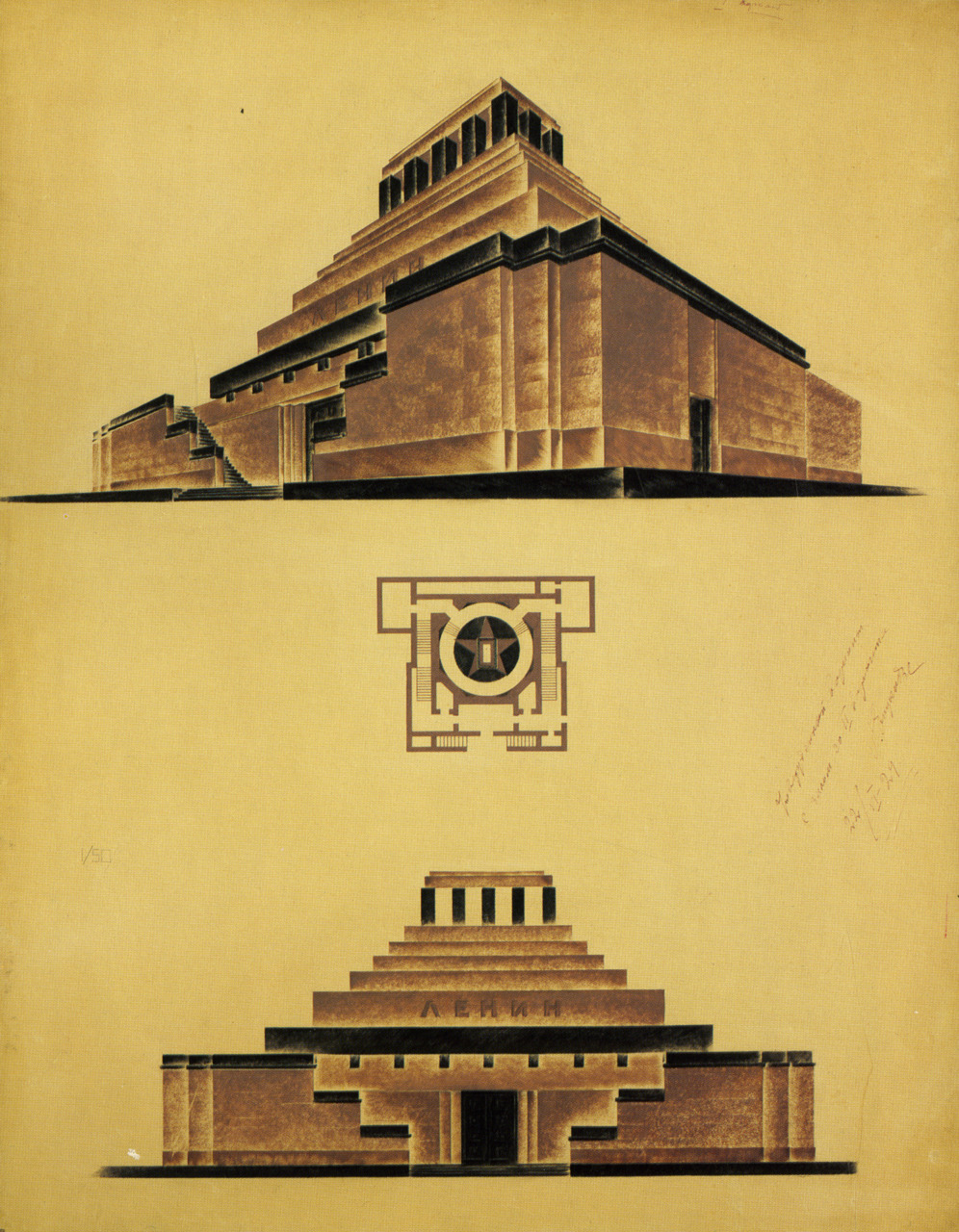
The instance of the mausoleum is of particular interest and in the case of Lenin’s it might even give us a hint as to the specificity of the modernist-authoritarians relationship to the sacred: the monument is individual in that it only celebrates one dead, whereas the awkward equivalent in our western democracies would either celebrate the abstracted heroe (The Unknown Soldier) or the collective (Cenotaphs). In both cases however, the paradoxical relationship, in modern societies, between the mourner and the mourned is one of a crowd claiming an personal, emotional, rather than ritualised or social relationship with the mourner. The ability for the "symbol" (Lenin, the Unknown Soldier) to sustain such intransigent connections with such a large amount of people might well participate to divinize him. 

Renato Nicolodi - Atrium I


"Fourth principle. Heterotopias are most often linked to slices in time - which 
is to say that they open onto what might be termed, for the sake of symmetry, 
heterochronies.The heterotopia begins to function at full capacity when men arrive 
at a sort of absolute break with their traditional time."

Michel Foucault, Of Other Spaces, 1967

When in The Total Art of Stalinism, Boris Groys describe the Avant Garde and the Socialist Realist art as both attempting at establishing themselves in an extrahistorical space, he does not address, maybe because it is so obvious, the shared monumentality of the two discussably opposite movements: Monuments are more than anything else Heterotopias of Time, they exist chiefly as a testament from the past to the future, a testament from an idealised past to an imaginary future. In that regard they deny the present but not the individual. The personal experience of the visitor is purely turned towards the past (memorials) or the future (the project) negotiating through the audience’s experience a unity between the contemporaneity and the mythical time. To achieve this the monument needs complete contemporaneity, that is no trace of quotes or composite aesthetics, a tension or paradoxe eminently exposed in Stefan Hoenerloh's paintings
The example selected for this type of Heterotopias is the library - this is obviously reminiscent of Borges Library of Babel, that is so monumental in it's proportion, that it is constituted of an indefinite or perhaps infinite repetition of the same space. Repetition is a characteristic of both the sacred and the industrialized, a feature I have come to consider as playing an essential part in modernist aesthetics, because in it's multitude, it isolate the object as a signifier. This is peculiarly obvious in Erik Desmazieres Escher-like illustrations (as shown here on the awesome blog of the awesome illustrator John Coultart) or the (less convincing) Michelle Lord "City of the Immortal" project. 
Unsurprisingly, Foucault’s 1964 lecture starts out on the fundamental duality of space and time, relating at time “anxiety of our era” to the overwhelming concern for space. The monumental could be seen as either confirming or countering this view: denying it as it expresses an urgent preocupation with time, and confirming it in it’s expression of this concern in terms of space.


Renato Nicolodi - Atrium I

...

"Looking back at the ruins of the twentieth century, we see more paradoxical mergers: between suprahuman state models and human practices, between individual aspirations and collective pressure, between ascending dreams and down-to-earth everyday survivals."

Svetlana Boym, Tatlin, or, Ruinophilia, 2007


Renato Nicolodi - Personal Museum II

The scale of Nicolodi's art works certainly participates of displacing them definitely from the space of the collective into the space of the individual: the ritual value is withdrawn and from an environment, the monument becomes an object, if not a tool. Whereas the environment in the ritual is meant t to manifest the limits, the duty or tradition, the tool itself is empowering, it is the conductor of action, and of symbolic action, by which the participant can interact with the tradition by either perpetuating it or transgressing it. 

Renato Nicolodi - Personal Museum II

This shift in the balance of power might transform the ritual from an oppressive method of enforcing the statu quo into an individualistic self assertion, making him into if maybe not a Demiurge in the sense of Boris Groys, at least a entity on the level of collective or impersonal ones, and his own decision as national interest. 

Renato Nicolodi - Personal Museum II